Skip to content

Category: Analysis

How much of a stronger dollar reaches the margin?

Exchange rate movements between the Swiss franc, US dollar, and euro directly affect manufacturers’ profit margins on international orders. Using a Swiss machinery manufacturer as an example, the analysis shows how currency fluctuations impact both revenue (in dollars) and costs (in dollars, with franc-denominated production costs), demonstrating that the timing of payments matters as much as the exchange rate itself in determining whether an order remains profitable.

The piece examines interest rate differentials between the Fed and Swiss National Bank, their partial influence on currency movements, and effects on importers, exporters, and businesses handling multiple currencies. It also addresses US tariffs on Swiss goods and offers practical guidance for companies on hedging strategies, including forward contracts and matching payment dates, to protect profit margins before finalizing quotations.

When the dollar gains eight Swiss centimes, a million dollars in sales is worth an extra 80,000 francs. The purchasing manager may have a better idea than the sales manager of how much the company gets to keep.

A Swiss machinery manufacturer sells a production line for a million dollars. At 76 centimes to the dollar, the sales manager expects revenue of 760,000 francs. At 84 centimes, that rises to 840,000. A welcome currency gain to report at the next management meeting, then. The purchasing manager is likely to have a question. What exchange rate are we paying for the control system and the drives?

It is a timely question. According to the European Central Bank, one euro bought 1.1974 dollars on 28 January 2026 and just 1.0968 on 18 November. On that same November day, a euro bought 0.9243 Swiss francs. That puts the dollar at 84.27 Swiss centimes. Anyone drawing up a budget for 2027 has to choose an exchange rate. For the machinery manufacturer, another figure matters more. How far can the dollar fall before the order ceases to pay?

What interest rates can explain

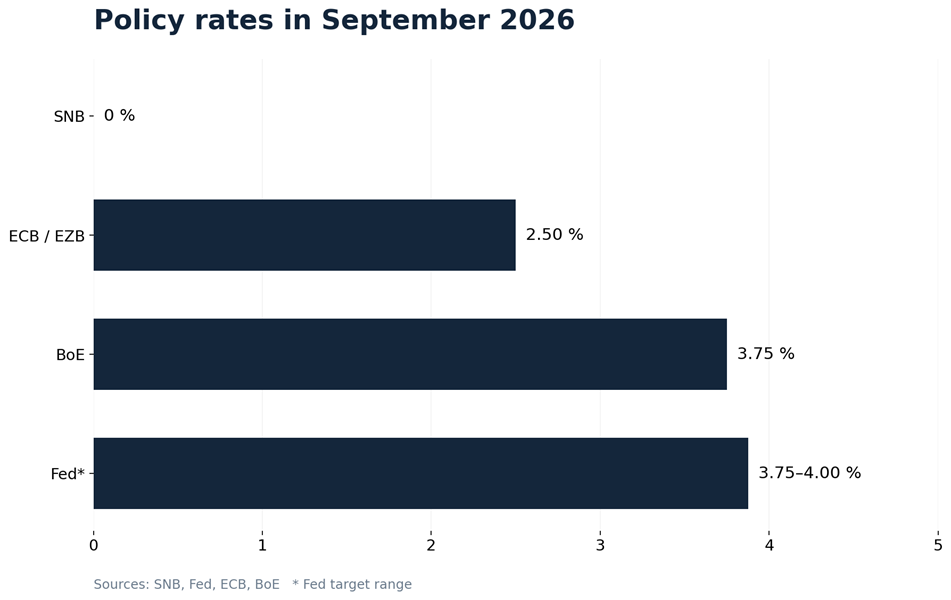
On 28 October, the US Federal Reserve kept its target range at 3.75 to 4 per cent. The Swiss National Bank had kept its policy rate at zero in September. That yield advantage makes dollar assets attractive to investors willing to bear the currency risk. If expectations change about how long the advantage will last, the exchange rate can move well before the next rate decision.

The rate differential is there for anyone to see. The two policy rates alone tell us little about how much of the dollar’s recent strength it explains. A European investor can buy US technology shares and simultaneously sell dollars forward. The investor then has exposure to US equities while limiting the currency risk. Enthusiasm for American AI companies is a slender basis for a dollar forecast.

For a small or medium-sized business, the distinction matters. A manufacturer that quotes a firm price and can earn its target margin only if the dollar keeps rising until payment has guaranteed its customer a price it has yet to secure for itself.

Where Europe feels the dollar first

At the ECB reference rate on 28 January, a European importer would have needed about 835,000 euros to settle a million-dollar invoice. By 18 November, it took almost 912,000 euros. The same invoice cost roughly 77,000 euros more. The supplier need not have raised its price, nor need oil have become more expensive. A dollar invoice and an unhedged exchange rate are enough.

With energy, the two effects can compound each other. If the dollar price of oil rises while the euro falls, a European buyer pays more for a barrel on both counts. Eurostat reported annual inflation of 4.0 per cent in the euro area in October. Energy cost 21.0 per cent more than a year earlier. That figure does not tell us how much of the increase came from the exchange rate. For a company on a fixed-price electricity contract, the date of the next negotiation may matter more than today’s market price.

For exporters, the outcome depends on who captures the price advantage. If a German manufacturer holds its euro price steady, its machine becomes cheaper in dollars for an American buyer. If the price was fixed in dollars, the customer pays the same and the manufacturer receives more euros. The same currency move cannot deliver both benefits in full.

One Swiss order in three currencies

A precision engineering firm in Aargau pays wages in francs, buys electronics in dollars and invoices a German customer in euros. A stronger dollar raises its purchasing costs. Whether the firm can absorb the increase also depends on the euro’s value against the franc. If rising costs prompt the German customer to postpone its next order, the Swiss supplier faces a sales risk on top of its currency risk. Its dollar account tells it little about that.

Swiss price data also reward a closer look. In October, consumer prices were 1.5 per cent higher than a year earlier. Imported goods were up 3.7 per cent and domestic goods 0.8 per cent. The national index tracks a household shopping basket. A workshop buying special steel, electricity and electronics needs its own purchase prices to cost a job.

US business brings tariffs into the calculation. Since 24 July 2026, an additional US duty on covered Swiss goods has generally brought the regular most-favoured-nation tariff up to a combined 12.5 per cent. A regular rate of 5 per cent therefore attracts an additional 7.5 percentage points. Where the regular rate is already at least 12.5 per cent, this additional duty does not apply. Exemptions and sector-specific rules make the tariff classification and origin of the goods relevant to every quotation. Who ultimately bears the cost also depends on the price negotiation.

The exchange rate at which the order tips into loss

Back to the machinery manufacturer. Suppose the million dollars in revenue is matched by 400,000 dollars in components. Manufacturing and assembly add another 450,000 francs in costs directly attributable to the order. The customer pays on acceptance. The supplier’s dollar invoice falls due the same day. Prices and quantities are fixed. The exchange rate is still open.

The dollar receipts and payments offset each other in part. That leaves 600,000 dollars to convert into francs. Each centime of exchange-rate movement changes the contribution margin by 6,000 francs. The eight-centime rise in our opening example therefore adds 48,000 francs to the margin. The other 32,000 francs cover the higher cost of the components.

CHF per USDNet proceeds after dollar purchasesContribution margin
0.76CHF 456,000CHF 6,000
0.84CHF 504,000CHF 54,000
0.90CHF 540,000CHF 90,000

Illustrative figures, assuming both payments fall on the same day and the exchange rate is unhedged.

At 75 centimes, the order just covers its directly attributable costs. Nothing is left for administration, selling expenses or profit. If management requires a contribution of at least 30,000 francs, the outstanding amount must fetch an average of 80 centimes to the dollar. That gives the sales team a figure it can use. It can ask for a higher price, renegotiate the component purchase or find out whether it can lock in the required rate until payment.

When the supplier wants paying first

In practice, dates rarely line up so neatly. If the supplier wants its 400,000 dollars in February and the customer pays only in June, the manufacturer needs cash in February. Buying dollars at 84 centimes then uses 336,000 francs. If the dollar falls to 76 centimes by June, the sale brings in just 760,000 francs. After the 450,000 francs for manufacturing and assembly, the order makes a negative contribution of 26,000 francs, even before financing costs.

In the first example, 76 centimes left a small surplus. In the second, the same order at the same closing rate makes a loss. All that changed was the date the components were paid for and the rate that applied that day. Every material foreign-currency amount therefore needs a date beside it. In this case, a customer deposit in dollars can achieve more than a long discussion about the right budget rate.

What to decide before the next quotation

The first decision sits with sales. How long is the price valid? Can the customer defer delivery? Have the components already been ordered? For a production line with a six-month lead time, it is worth arranging for the customer’s dollar deposit to fall due when the main components are ordered. Purchasing can use the money directly. A dollar account makes settlement easier. The protection extends only as far as the amounts and dates match.

A currency forward may make sense for the remaining amount. The exporter agrees today how many francs it will receive for its dollars on a specified date. When dollar interest rates are higher, all else being equal, the forward rate in francs per dollar is below the spot rate. The gap mainly reflects the interest-rate differential over the term. The figure that belongs in the costing is the bank’s firm quote, including its margin.

How much should the manufacturer hedge? In our example, the bank’s quote should be measured against the 80-centime threshold if the order is to contribute 30,000 francs. A signed contract with a fixed payment date calls for a different decision from a tender with several bidders still in the running. A company that sells dollars forward and loses the tender has to source those dollars elsewhere. Late payment can also mean arranging bridging finance or adjusting the forward contract.

There is a further decision when the company invests in its own equipment. If it buys an American milling machine, it may carry currency risk between placing the dollar order and the finance provider taking over the purchase. A lease quotation in francs settles the question only once the conversion date and exchange rate for the purchase price are fixed. Fixed franc instalments can then make expenditure predictable over the machine’s useful life. A comparison with a loan should include any higher initial instalment, fees, residual value and any purchase price payable at the end. Whether the machine earns its keep will still depend on how much it is used.

At the next budget meeting, I would ask the heads of sales and purchasing to work through one outstanding large order together. Which amounts are binding? When does the money change hands? At what rate do we fall below our minimum margin? For our manufacturer, the answer to the last question is 80 centimes, provided both dollar payments fall due on the same day. Management then knows what it has to decide, even if nobody in the room knows where the dollar will be in June.

Sources:

[1] ECB, reference rates for the US dollar and Swiss franc

[2] Fed, 28 October

[3] SNB, 24 September

[4] Eurostat, October inflation

[5] FSO, October consumer prices

[6] SECO, Swiss–US trade relations

[7] BIS, interest rate parity and forward exchange rates

Comments closed


Change cannot be delegated

Effective organizational change depends on leadership behavior rather than announcements or delegated project teams. Drawing on Kotter’s analysis of failed transformations, the discussion argues that contradictory signals, unclear accountability, and unresolved trade-offs undermine change efforts more than outright resistance. Sound decisions require precise problem definition, honest cost assessment including hidden coordination effort, and clear decision rights before implementation begins.

For Swiss SMEs specifically, the analysis emphasizes financial scenario planning, customer-informed decision-making, and involving frontline employees without granting veto power. It recommends balanced indicators, explicit criteria for stopping initiatives, and board oversight focused on assumptions and follow-through rather than metrics alone. The central distinction offered is whether change makes a company genuinely stronger or merely larger and more complex.

Leadership in times of change

Transformation rarely fails because of a concept alone. It fails when decisions are not translated into everyday practice.

The business challenge

When a service-sector SME introduces a new industry-specific system, management can order the software. Whether it is used, however, is decided in everyday workflows. Employees need to understand which old steps disappear and who makes decisions when errors occur.

In the Harvard Business Review in 1995, John Kotter described typical mistakes in change initiatives. They include a lack of urgency, an insufficiently strong guiding coalition, a poorly communicated vision and declaring success too early. These patterns can be observed in SMEs as well as large corporations.

What is often overlooked

Change often fails not because of fundamental rejection but because of contradictory signals. When managers demand new processes while continuing to maintain their own shadow Excel lists, the old organisation remains intact.

Communication does not replace leadership. Change requires understandable decisions, consistency and opportunities for feedback. Unclear responsibilities, by contrast, quickly breed cynicism.

Implications for Swiss SMEs

For every change, the objective, responsible person, verifiable milestones and possible unwanted side effects should be set out in writing. Old ways of working should be systematically discontinued after a transition period. Conflicts that arise must be discussed openly.

The most credible change plan is the behaviour of the leadership team.

The business fundamentals

The question of leadership responsibility during change is not a stand-alone specialist matter. It determines how a company uses scarce time, skilled people and capital. A manufacturing company introduces a new planning system. In a management presentation, this situation can often be summarised in a single line. In reality, however, the consequences emerge through a chain of decisions: a customer asks for a commitment, a team makes an assumption, an investment is approved, and only months later does it become clear whether the economics hold up. Anyone who fails to understand this chain confuses a good intention with a good business model.

Management delegates decisions to a project team without a mandate. That is where the real difficulty lies. The problem rarely takes the form of one major mistake. It is spread across proposals, contracts, workflows and budgets. Each department may do its part correctly while the overall result remains unsatisfactory. Effective executive management must therefore assess the economic impact across departmental boundaries. It asks not merely whether a measure has been implemented, but what demonstrable benefit remains after all subsequent costs.

Why simple answers are rarely enough

The temptation to reach for a quick solution is understandable. An additional employee, new software, a larger budget or another control has an immediate effect. Yet each of these responses can create new dependencies. When it comes to leadership responsibility during change, it is therefore worth distinguishing between symptoms and causes. Has a bottleneck really arisen because there is too little capacity? Or is existing capacity tied up by unnecessary work? Is a market missing, or is the offering simply not compelling enough for existing customers?

A sound decision begins with a precise definition of the problem. This includes the starting position, the customers affected, the financial implications and the question of what would happen without intervention. Only then should the discussion turn to tools. An approach based on clear sponsors, decision rights and day-to-day leadership may make sense. But it is not a universal answer. The method must fit the business model, the company’s capacity to bear risk and the capabilities available. Otherwise, the result is another change process with certain costs and uncertain benefits.

A business example

Consider the following explicitly illustrative situation: a manufacturing company introduces a new planning system. Executive management discusses an obvious measure and expects a rapid improvement. The calculation takes direct expenditure into account, but not the additional coordination effort, possible delays or demands on key people. On paper, the initiative looks more attractive than it proves to be in day-to-day operations.

An alternative approach would first answer three specific questions. What exactly should change for the customer? Which labour or capital resources will this release or tie up additionally? And how will the company know after six months whether the change has been successful? The actual investment decision follows only once these answers are reliable. The example provides no universally applicable figure and is not intended to describe an actual business. Rather, it shows how much the quality of a decision can differ even when both approaches begin with the same worthwhile objective.

The hidden costs

Strategic and operational initiatives incur costs that are barely visible in conventional budget lines. Managers have to prepare decisions, specialists test new workflows, customers ask follow-up questions, and old procedures often continue in parallel for a while. These costs do not always appear on a supplier’s invoice. They arise as committed working time, delayed orders or alternatives left unexplored. Particularly in smaller companies with few specialists, this assessment of opportunity costs can matter more than the purchase price.

Management delegates decisions to a project team without a mandate. A careful business case therefore captures not only one-off project costs but also training, maintenance, troubleshooting, control effort and the time needed to reach stable operations. Where values cannot be determined precisely, transparent ranges are more honest than apparently exact decimal places. The crucial question is whether the initiative remains affordable under plausibly adverse conditions. A project that pays off only when implementation is perfect is not a robust investment.

Choosing the right indicators

What is measured shapes behaviour. For this topic, usage rate, process errors, acceptance are particularly relevant. However, indicators must not become targets without scrutiny. A shorter processing time is worthless if the error rate rises. A high conversion rate can be problematic if it is bought through unprofitable discounts. And strong short-term cash flow may result from postponing necessary investments.

A small, balanced set of measures is useful. It combines results, quality, risk and customer impact. Each figure needs a clear definition, a data source and an accountable person. Executive management should also determine what decision follows from a change. If an indicator declines but nobody does anything differently, it is probably more about reporting than steering the business. Comparison with the company’s own baseline is important too. Industry averages can provide orientation, but they do not replace attention to the particular business model.

Accountability and decision rights

The CEO, line managers and employees often view the same decision from different perspectives. This is not a mistake; it is necessary. An economically attractive solution may be technically unreliable; a legally permissible measure may damage customer trust; an operationally convenient procedure may tie up capital unnecessarily. This diversity becomes a problem only when nobody explicitly resolves the trade-offs.

Clear accountability is therefore essential. Who is responsible for the outcome? Who may approve exceptions? Who assesses the risks independently? And who checks after implementation whether the promised improvements have materialised? These answers should be settled before the project begins. A working group can gather information and develop proposals. But it cannot replace executive management that sets priorities and takes responsibility for uncomfortable trade-offs. Formal committees are not always necessary, especially in small companies; clarity about rights and duties certainly is.

The case against the preferred solution

A serious analysis must also allow the opposing view. Too much top-down pressure can intensify resistance. This argument is not merely a footnote. It can make the difference between a sensible measure and a costly mistake. Before approval, the company should therefore ask explicitly which assumption could cause the initiative to fail. Such an objection is not a sign of disloyalty, but a contribution to decision quality.

Executive management can appoint someone to argue deliberately against the preferred solution. Which customers might react differently? What additional costs have been overlooked? What new dependency will arise? Which alternative would require less capital? This does not mean automatically choosing the most cautious option afterwards. The task is to take risks consciously, rather than overlook them through enthusiasm or time pressure. Entrepreneurial initiative and critical scrutiny are not opposites.

Financial viability and liquidity

Every strategic measure uses resources before its benefits become fully visible. Even if an investment pays off over its lifetime, it may put pressure on liquidity in the short term. An additional market presence requires upfront spending; new technology ties up capital; organisational changes temporarily reduce productivity. Profitability and the ability to meet payments must therefore be considered separately.

A simple financial scenario analysis is advisable when dealing with leadership responsibility during change. It sets out a plausible normal course, an adverse course and a course in which benefits are delayed. For each case, the capital required, available reserves and possible countermeasures are described. A company does not need to be able to finance every imaginable shock. But it should know at what level of deviation a project must be stopped, reduced in scope or renegotiated. These limits are easier to set before investing than in the middle of a crisis.

The customer perspective and market position

Internal efficiency alone does not create a competitive advantage. The change must either improve the service delivered to the customer, provide the same benefit more economically or reduce risks that the customer actually bears. It is therefore worth seeking customers’ views before making a decision. Which problems cost them time or money? What are they willing to pay for? And which features do we consider important internally even though they hardly influence the purchasing decision?

Swiss SMEs in particular can make use of their proximity to demanding customers. They often receive direct feedback and can respond more quickly than large organisations. This advantage is lost if feedback stays within the department responsible. Sales, development, production and service should jointly identify where a recurring customer problem can be translated into a better offering. When it comes to leadership responsibility during change, the customer perspective is therefore not merely an addition to the business case, but an essential part of it.

People and implementation

A decision takes effect only through employees’ behaviour. New procedures may make technical sense and still fail if they are too complicated to apply or those affected see no benefit. Managers should therefore explain early on which problem is to be solved, which habits will change and which skills will be needed in future. Transparency does not remove every disagreement, but it makes a factual discussion easier.

When dealing with leadership responsibility during change, it is particularly important to involve the people who work with the processes every day. They know the exceptions, informal workarounds and actual customer requirements. This experience must not be confused with a right of veto. Executive management remains accountable. Yet anyone who designs a process without the people who perform it risks creating a technically sound but practically unusable solution. Training, feedback and a willingness to make corrections therefore belong in the timetable and budget from the outset.

A sound decision-making process

The next step does not have to be a large programme. An SME can begin with a clearly defined question: which specific problem causes the greatest economic damage, and what change can be tested with a reasonable amount of effort? Baseline values are then documented, an accountable person is appointed and a review date is set. An approach based on clear sponsors, decision rights and day-to-day leadership offers one possible framework.

It is important that testing does not become an end in itself. A pilot should prepare a real decision: expand, adapt or stop. The criteria for stopping should be discussed before the start. This protects against the common reflex of sticking with an initiative simply because money and reputation have already been invested. Short written decision notes are particularly helpful. They record which assumptions applied at the time. Later, this makes it easier to distinguish whether an outcome resulted from bad luck, changed circumstances or flawed reasoning.

What is distinctive about Switzerland

For many companies, Switzerland offers a demanding, affluent and internationally connected market. At the same time, high labour costs, limited availability of skilled people and intense international competition increase the pressure to use resources wisely. These conditions justify neither indiscriminate cost cutting nor every new technology. Rather, they increase the value of precise decisions. A company that promises quality must deliver it reliably; one that differentiates itself through specialisation must not scatter its capabilities indiscriminately.

For Swiss SMEs, the size of the organisation is also a double-edged characteristic. Short communication lines enable rapid change. Conversely, the absence of one key person can stop an entire project. Leadership responsibility during change should therefore not be considered solely in terms of short-term returns. Dependence on individuals, the transferability of knowledge and the ability to remain capable of acting under changing market conditions are equally relevant.

What the board of directors should examine

The board does not need to manage operational details, but it does need a clear understanding of the main assumptions. It should be able to see which opportunities management is pursuing, which alternatives have been rejected and what financial risks are involved. A presentation full of indicators is less useful for this purpose than a precise answer to the question of what happens in an adverse scenario.

Implementation also belongs on the agenda when considering leadership responsibility during change. Was the measure introduced as planned? Did the promised benefit materialise? Have new risks emerged? And if the outcome is disappointing, what consequences does executive management draw from it? These questions are not an expression of mistrust. They ensure that strategic decisions do not end with approval. Good governance requires follow-through without blurring the responsibilities of operational management.

Looking ahead to the next twelve months

An annual plan for this topic should contain a few verifiable steps. First, the starting position is described using usage rate, process errors, acceptance. Executive management then determines which change genuinely has priority. A limited test or an initial implementation stage follows. Finally, a decision is made at a predetermined point on whether to continue, adapt or stop the approach. Reviewing assumptions on the following basis – weekly implementation reviews – helps avoid waiting until an entire financial year has passed.

The plan should also state what will deliberately not be done. Without this decision, new initiatives are launched on top of day-to-day business rather than replacing less important work. The result is overload, not progress. A good twelve-month plan therefore links objectives to available capacity and a realistic sequence. Its quality is reflected not in the number of projects, but in whether the key decisions are actually implemented and their results understood.

The decisive question

In the end, the discussion comes down to one central business question: will the planned change make the company economically stronger and more resilient, or simply larger, more complex and busier? This distinction is particularly important in relation to leadership responsibility during change. An activity can look modern while creating little value. An unremarkable improvement, by contrast, can stabilise margins, retain customers and relieve scarce skilled staff.

Leadership means recognising these differences and acting on them. It requires the courage to invest, but also a willingness to stop an initiative. It requires indicators without reducing people to numbers. And it requires long-term goals without jeopardising the company’s short-term ability to pay. What matters is not how convincingly a measure is announced. What matters is whether its impact becomes visible in the business.


Source

https://hbr.org/1995/05/leading-change-why-transformation-efforts-fail-2

Comments closed

Selling is no longer enough. The customer wants a solution.

Customers purchase production capability and economic outcomes rather than machines themselves, prompting manufacturers to shift from product-focused sales toward solution-based business models including maintenance contracts, pay-per-use, and availability guarantees. This transition offers Swiss industrial companies competitive advantages over lower-cost manufacturers but requires transparent service costing, life-cycle calculations, clear data governance, and sound financing structures to avoid underpriced commitments and liquidity risks.

Successfully implementing these models demands rigorous decision-making beyond simple solutions. Companies must distinguish symptoms from root causes, account for hidden coordination costs, establish balanced performance indicators, and assign clear accountability across sales, engineering, and service functions. Deliberately challenging preferred solutions before approval helps identify overlooked risks, ensuring that service promises are economically viable rather than enthusiastically oversold commitments.

Developing new business models

Customers do not buy a machine for its own sake. They buy production capability, reliability and an economic outcome.

From the product to the economic outcome

A customer rarely orders a machine because owning a machine is the objective. The customer wants to produce, meet delivery deadlines, safeguard quality and serve its own customers. The equipment is a means to that end. This simple observation changes the perspective on sales and product development: what matters is not only what a manufacturer delivers, but what economic outcome it enables for the customer.

This shift in perspective opens opportunities for Swiss industrial companies. Comparing only the purchase price quickly brings them into competition with manufacturers in lower-cost countries. Being able to offer availability, process knowledge, maintenance and support throughout the equipment’s life changes the basis of comparison. But it also creates new responsibilities. Promised availability is valuable only if the supplier can actually deliver and finance it.

Services are not a free add-on

Many manufacturers already provide advice, commissioning, training or maintenance. However, these services are often inadequately costed or treated as an automatic extra. This is problematic for two reasons. First, the true effort disappears into the product margin. Second, customers learn to regard valuable services as free. A professional service business therefore begins with transparency: which services are included in the purchase price, which are charged separately, and what measurable benefit do they deliver?

A maintenance contract, for example, can reduce unplanned failures and extend the life of equipment. The manufacturer must provide spare parts, qualified technicians and response times to achieve this. These costs arise even when the customer rarely uses the service. A sensible calculation therefore considers not only average call-outs, but also reserve capacity, travel time and the likelihood of expensive exceptional cases.

The route to recurring revenue

Recurring revenue looks attractive at first: it improves predictability and deepens the customer relationship. Yet the form of revenue alone says nothing about profitability. A poorly costed service contract can cause losses for years. A usage-based model can increase the financing burden and put pressure on liquidity. A company introducing such an offering must therefore calculate the entire life cycle.

This includes development, installation, operation, maintenance, software upkeep, spare parts, customer support, financing and possible take-back or disposal. The costs of early contract termination must also be included. A model that looks attractive at ideal utilisation can become uneconomic when usage fluctuates. A reliable calculation therefore needs several scenarios rather than a single optimistic sales assumption.

Three models, three different risks

In a conventional product sale, the manufacturer receives the purchase price and assumes defined warranty and service obligations. A sale combined with a maintenance contract generates additional recurring revenue, but also longer-term performance obligations. In a pay-per-use or availability model, responsibility shifts further: depending on the contract structure, the supplier or a financing partner bears ownership, financing and residual-value risks. These models must not be grouped into a single category.

A gradual development can make particular sense for SMEs. First, a clearly costed maintenance contract is offered. This may then be followed by condition-based maintenance, provided the necessary data are available. A more outcome-oriented model should be considered only once usage, failures and costs can be measured reliably. Guaranteeing the customer’s entire benefit too early may mean taking on risks that the company can neither control nor price.

Data create benefits and obligations

Connected machines provide information about running hours, temperature, wear and faults. These data can help improve maintenance planning and avoid downtime. But they also raise questions: who owns the data contractually? Who may analyse them? Which information allows conclusions to be drawn about the customer’s production? What security requirements apply to remote access?

The supplier must settle these questions before entering the market. A customer is unlikely to release sensitive operational data if the purpose, protection and use remain unclear. Conversely, a manufacturer should not imply that every collected metric automatically produces a reliable failure forecast. Data quality, a sufficiently long observation period and technical limits determine what can credibly be promised.

Financing must not disappear into sales

When a manufacturer sells usage rather than the machine itself, it often no longer receives the full purchase price on delivery. At the same time, it has to manufacture or procure the equipment. This timing difference ties up capital. It can become a bottleneck for a growing supplier even if its customers are profitable over the long term.

Financing and leasing partners can help structure this burden. That does not relieve the manufacturer of the need for a sound contractual framework. Who owns the equipment? Who bears the risk of a technical defect? Who is responsible for insurance, maintenance and return? What payments arise if the contract is breached? The clearer the answers, the lower the risk that an attractive sales promise will later become an expensive dispute.

Demonstrating customer value

Moving to solutions requires a different approach to sales. Rather than listing technical features, the supplier has to understand the customer’s economics. What does an hour of downtime cost? How frequently do faults occur? What costs arise from scrap? What response times does production require? These questions provide the foundation for a credible value proposition.

Customers should be able to understand the assumptions behind a financial calculation. Promised savings are not facts until they have been measured. A pilot with selected customers can help document actual effects and adapt the offering. That is less spectacular than an immediate change of model, but often makes better economic sense.

Growth requires a clear allocation of risk

For executive management, a new service or usage model belongs on the same agenda as a major investment. It requires a calculation of capital needs, assigned responsibilities, risk limits and indicators covering the contract’s term. What matters is not only new contracts signed, but contribution margin, actual service costs, bad debts, equipment availability and customer retention.

The move from product to solution is not a departure from machinery manufacturing. It is an extension of the business model. The best machine remains worthless if it provides no economic advantage for the customer. Conversely, well-supported equipment can be attractive even when its purchase price is not the lowest.

Conclusion

Sometimes innovation lies less in the product than in how its benefit is made available.

The business fundamentals

The question of economic customer benefit rather than product features is not a stand-alone specialist matter. It determines how a company uses scarce time, skilled people and capital. An equipment manufacturer offers maintenance and availability. In a management presentation, this situation can often be summarised in a single line. In reality, however, the consequences emerge through a chain of decisions: a customer asks for a commitment, a team makes an assumption, an investment is approved, and only months later does it become clear whether the economics hold up. Anyone who fails to understand this chain confuses a good intention with a good business model.

Service promises are sold before their operational costs have been calculated. That is where the real difficulty lies. The problem rarely takes the form of one major mistake. It is spread across proposals, contracts, workflows and budgets. Each department may do its part correctly while the overall result remains unsatisfactory. Effective executive management must therefore assess the economic impact across departmental boundaries. It asks not merely whether a measure has been implemented, but what demonstrable benefit remains after all subsequent costs.

Why simple answers are rarely enough

The temptation to reach for a quick solution is understandable. An additional employee, new software, a larger budget or another control has an immediate effect. Yet each of these responses can create new dependencies. When it comes to economic customer benefit rather than product features, it is therefore worth distinguishing between symptoms and causes. Has a bottleneck really arisen because there is too little capacity? Or is existing capacity tied up by unnecessary work? Is a market missing, or is the offering simply not compelling enough for existing customers?

A sound decision begins with a precise definition of the problem. This includes the starting position, the customers affected, the financial implications and the question of what would happen without intervention. Only then should the discussion turn to tools. An approach based on life-cycle costing and a service organisation may make sense. But it is not a universal answer. The method must fit the business model, the company’s capacity to bear risk and the capabilities available. Otherwise, the result is another change process with certain costs and uncertain benefits.

A business example

Consider the following explicitly illustrative situation: an equipment manufacturer offers maintenance and availability. Executive management discusses an obvious measure and expects a rapid improvement. The calculation takes direct expenditure into account, but not the additional coordination effort, possible delays or demands on key people. On paper, the initiative looks more attractive than it proves to be in day-to-day operations.

An alternative approach would first answer three specific questions. What exactly should change for the customer? Which labour or capital resources will this release or tie up additionally? And how will the company know after six months whether the change has been successful? The actual investment decision follows only once these answers are reliable. The example provides no universally applicable figure and is not intended to describe an actual business. Rather, it shows how much the quality of a decision can differ even when both approaches begin with the same worthwhile objective.

The hidden costs

Strategic and operational initiatives incur costs that are barely visible in conventional budget lines. Managers have to prepare decisions, specialists test new workflows, customers ask follow-up questions, and old procedures often continue in parallel for a while. These costs do not always appear on a supplier’s invoice. They arise as committed working time, delayed orders or alternatives left unexplored. Particularly in smaller companies with few specialists, this assessment of opportunity costs can matter more than the purchase price.

Service promises are sold before their operational costs have been calculated. A careful business case therefore captures not only one-off project costs but also training, maintenance, troubleshooting, control effort and the time needed to reach stable operations. Where values cannot be determined precisely, transparent ranges are more honest than apparently exact decimal places. The crucial question is whether the initiative remains affordable under plausibly adverse conditions. A project that pays off only when implementation is perfect is not a robust investment.

Choosing the right indicators

What is measured shapes behaviour. For this topic, availability, service costs and contract margin are particularly relevant. However, indicators must not become targets without scrutiny. A shorter processing time is worthless if the error rate rises. A high conversion rate can be problematic if it is bought through unprofitable discounts. And strong short-term cash flow may result from postponing necessary investments.

A small, balanced set of measures is useful. It combines results, quality, risk and customer impact. Each figure needs a clear definition, a data source and an accountable person. Executive management should also determine what decision follows from a change. If an indicator declines but nobody does anything differently, it is probably more about reporting than steering the business. Comparison with the company’s own baseline is important too. Industry averages can provide orientation, but they do not replace attention to the particular business model.

Accountability and decision rights

Sales, engineering and customer service often view the same decision from different perspectives. This is not a mistake; it is necessary. An economically attractive solution may be technically unreliable; a legally permissible measure may damage customer trust; an operationally convenient procedure may tie up capital unnecessarily. This diversity becomes a problem only when nobody explicitly resolves the trade-offs.

Clear accountability is therefore essential. Who is responsible for the outcome? Who may approve exceptions? Who assesses the risks independently? And who checks after implementation whether the promised improvements have materialised? These answers should be settled before the project begins. A working group can gather information and develop proposals. But it cannot replace executive management that sets priorities and takes responsibility for uncomfortable trade-offs. Formal committees are not always necessary, especially in small companies; clarity about rights and duties certainly is.

The case against the preferred solution

A serious analysis must also allow the opposing view. Performance promises can create liabilities that cannot be controlled. This argument is not merely a footnote. It can make the difference between a sensible measure and a costly mistake. Before approval, the company should therefore ask explicitly which assumption could cause the initiative to fail. Such an objection is not a sign of disloyalty, but a contribution to decision quality.

Executive management can appoint someone to argue deliberately against the preferred solution. Which customers might react differently? What additional costs have been overlooked? What new dependency will arise? Which alternative would require less capital? This does not mean automatically choosing the most cautious option afterwards. The task is to take risks consciously, rather than overlook them through enthusiasm or time pressure. Entrepreneurial initiative and critical scrutiny are not opposites.


Quellen

https://doi.org/10.1016/0263-2373(88)90033-3

Comments closed

The productivity trap

Growth in revenue and headcount does not automatically translate into productivity gains, and can mask organisational inefficiency. The content argues that businesses, particularly Swiss SMEs, should focus on value added per working hour rather than staff numbers, examining whether employees’ time is spent solving problems or absorbed by administrative friction between departments.

It recommends simplifying processes before digitalising them, using released capacity for advice or quality improvements rather than treating programmes as disguised downsizing, and applying clear metrics with defined accountability. Leadership should ask what customer benefit, resource changes and risks result from decisions, test assumptions through deliberate counterarguments, and prioritise a small number of measurable initiatives over multiple simultaneous changes.

Productivity rather than headcount growth

More revenue and more employees do not yet amount to a productivity gain. Growth can even conceal organisational inefficiency.

Why headcount is not a measure of success

If a company can handle additional orders only by creating additional jobs, this is not in itself evidence of strength. It may equally mean that every new order triggers the same administrative loops. Revenue rises, the workforce grows and the organisation becomes more complicated. In the end, managers are busy, but economic output per hour stagnates. This is particularly dangerous in a high-wage country. An SME cannot pass unlimited costs on to its customers. It has to create more benefit from scarce working hours.

The question is therefore not how many people a business employs, but what work those people perform. Skilled staff should solve customer problems, optimise equipment, safeguard quality or develop new products. If they spend a substantial part of their time transferring information between systems, resolving queries or correcting errors, this is not a staffing problem. It is an organisational problem.

What productivity actually measures

Productivity describes the relationship between output delivered and resources used. In business management, it is often reduced to revenue per employee. This can be misleading: a trading company with a high proportion of material inputs generates different revenue figures from an engineering consultancy. Depending on the business model, value added per working hour, contribution margin per productive hour or cost per order processed without errors can be more meaningful. These indicators must also be considered in context. Higher throughput bought at the expense of complaints and rework is not sustainable progress.

The OECD highlights substantial productivity differences between company sizes in Switzerland. These data are a reason to investigate, not a judgement on every SME. A highly specialised small business can be extremely productive; a large corporation can suffer from complex processes. What matters is whether a company can measure its own development properly over several years. A single monthly figure says little if order mix, purchasing prices and capacity utilisation fluctuate.

The invisible cost of poor processes

Many companies record costs by cost centre but rarely by process step. They know the staffing cost of their back office. Yet they do not know how often an order comes back because information is missing, how many emails an approval triggers or how long an invoice waits for clarification. The friction remains invisible because it is spread across many departments. Nobody bears the full cost, so nobody feels responsible for eliminating it.

A simple example illustrates the problem. An order is entered by sales, entered again by scheduling, supplemented by accounting and checked once more when a change is made. Each individual step seems small. Across hundreds of orders, minutes add up to weeks. If errors become visible only at the customer’s end, discounts, queries and lost trust add to the cost. Another software module will not remove this friction unless someone redesigns the end-to-end process.

Simplify first, then digitalise

Digitalisation is often the obvious answer to inefficiency. Yet a poor process does not become good merely because it runs electronically. Moving five unnecessary approvals into a workflow system creates five unnecessary digital approvals. The correct sequence is more demanding: make the workflow visible, remove unnecessary steps, clarify responsibilities, capture data only once and automate only afterwards.

For executive management, this means thinking beyond IT projects alone. A process owner must be able to explain which customer problem the workflow solves, which steps are essential and where a decision actually creates value. The greatest improvements often lie at the interfaces between sales, operations, finance and customer service. This is precisely where conventional departmental budgets end and costs that nobody sees in full begin.

Relieve staff rather than replace them

Productivity programmes fail when employees primarily see them as a concealed downsizing agenda. Being open about using released capacity for advice, better quality or additional orders creates a different starting point. Honesty is part of this: not every activity will remain unchanged, and some skills will need to be developed further. Training is therefore not a pleasant extra, but part of the economic calculation.

An industrial business that automatically prepares inspection reports gains something only if its specialists can assess the results more quickly and remedy deviations more effectively. An accounting and fiduciary services firm that reads documents automatically creates value when it offers clients more advice rather than merely more accounting entries. The benefit lies not in the click saved, but in using working time more productively.

The role of leadership

A manager should not ask only whether their department stayed within budget. They should know which work disappeared during the last quarter, how throughput times changed and whether customers have less work to do. One particularly revealing question is which activities nobody would miss if they disappeared tomorrow. It is uncomfortable because it also touches on cherished routines and responsibilities that have grown historically.

Productivity also requires clear priorities. Launching ten improvement initiatives at once adds to the organisation’s burden. A manageable programme is better: select an important process, measure the baseline, simplify it with the employees concerned, review the result and only then extend it elsewhere. A pilot without measurable improvement is not a success simply because the software works.

Four questions for the next executive decision

Before hiring or making a major investment, a sober assessment is worthwhile. First: what additional customer benefit will arise? Second: which part of the existing work could disappear? Third: how will value added per hour change, rather than merely the volume of work? Fourth: what risks to quality, data protection or employees does the change introduce? Answering these questions properly gives staffing and technology decisions a common economic foundation.

The most productive business is not necessarily the one with the fewest employees. It is the one that uses its people’s abilities most effectively. For Swiss SMEs, this is not an academic indicator but a prerequisite for remaining successful despite high costs, skills shortages and international competition.

Conclusion

The strength of a company is determined not by the size of its workforce, but by the value that workforce creates.

The business fundamentals

The question of value added per working hour is not a stand-alone specialist matter. It determines how a company uses scarce time, skilled people and capital. An industrial business enters the same order several times. In a management presentation, this situation can often be summarised in a single line. In reality, however, the consequences emerge through a chain of decisions: a customer asks for a commitment, a team makes an assumption, an investment is approved, and only months later does it become clear whether the economics hold up. Anyone who fails to understand this chain confuses a good intention with a good business model.

Growth increases the number of queries and coordination tasks. That is where the real difficulty lies. The problem rarely takes the form of one major mistake. It is spread across proposals, contracts, workflows and budgets. Each department may do its part correctly while the overall result remains unsatisfactory. Effective executive management must therefore assess the economic impact across departmental boundaries. It asks not merely whether a measure has been implemented, but what demonstrable benefit remains after all subsequent costs.

Why simple answers are rarely enough

The temptation to reach for a quick solution is understandable. An additional employee, new software, a larger budget or another control has an immediate effect. Yet each of these responses can create new dependencies. When it comes to value added per working hour, it is therefore worth distinguishing between symptoms and causes. Has a bottleneck really arisen because there is too little capacity? Or is existing capacity tied up by unnecessary work? Is a market missing, or is the offering simply not compelling enough for existing customers?

A sound decision begins with a precise definition of the problem. This includes the starting position, the customers affected, the financial implications and the question of what would happen without intervention. Only then should the discussion turn to tools. An approach based on process simplification before automation may make sense. But it is not a universal answer. The method must fit the business model, the company’s capacity to bear risk and the capabilities available. Otherwise, the result is another change process with certain costs and uncertain benefits.

A business example

Consider the following explicitly illustrative situation: an industrial business enters the same order several times. Executive management discusses an obvious measure and expects a rapid improvement. The calculation takes direct expenditure into account, but not the additional coordination effort, possible delays or demands on key people. On paper, the initiative looks more attractive than it proves to be in day-to-day operations.

An alternative approach would first answer three specific questions. What exactly should change for the customer? Which labour or capital resources will this release or tie up additionally? And how will the company know after six months whether the change has been successful? The actual investment decision follows only once these answers are reliable. The example provides no universally applicable figure and is not intended to describe an actual business. Rather, it shows how much the quality of a decision can differ even when both approaches begin with the same worthwhile objective.

The hidden costs

Strategic and operational initiatives incur costs that are barely visible in conventional budget lines. Managers have to prepare decisions, specialists test new workflows, customers ask follow-up questions, and old procedures often continue in parallel for a while. These costs do not always appear on a supplier’s invoice. They arise as committed working time, delayed orders or alternatives left unexplored. Particularly in smaller companies with few specialists, this assessment of opportunity costs can matter more than the purchase price.

Growth increases the number of queries and coordination tasks. A careful business case therefore captures not only one-off project costs but also training, maintenance, troubleshooting, control effort and the time needed to reach stable operations. Where values cannot be determined precisely, transparent ranges are more honest than apparently exact decimal places. The crucial question is whether the initiative remains affordable under plausibly adverse conditions. A project that pays off only when implementation is perfect is not a robust investment.

Choosing the right indicators

What is measured shapes behaviour. For this topic, throughput time, rework and value added per hour are particularly relevant. However, indicators must not become targets without scrutiny. A shorter processing time is worthless if the error rate rises. A high conversion rate can be problematic if it is bought through unprofitable discounts. And strong short-term cash flow may result from postponing necessary investments.

A small, balanced set of measures is useful. It combines results, quality, risk and customer impact. Each figure needs a clear definition, a data source and an accountable person. Executive management should also determine what decision follows from a change. If an indicator declines but nobody does anything differently, it is probably more about reporting than steering the business. Comparison with the company’s own baseline is important too. Industry averages can provide orientation, but they do not replace attention to the particular business model.

Accountability and decision rights

Production management, back-office staff and employees often view the same decision from different perspectives. This is not a mistake; it is necessary. An economically attractive solution may be technically unreliable; a legally permissible measure may damage customer trust; an operationally convenient procedure may tie up capital unnecessarily. This diversity becomes a problem only when nobody explicitly resolves the trade-offs.

Clear accountability is therefore essential. Who is responsible for the outcome? Who may approve exceptions? Who assesses the risks independently? And who checks after implementation whether the promised improvements have materialised? These answers should be settled before the project begins. A working group can gather information and develop proposals. But it cannot replace executive management that sets priorities and takes responsibility for uncomfortable trade-offs. Formal committees are not always necessary, especially in small companies; clarity about rights and duties certainly is.

The case against the preferred solution

A serious analysis must also allow the opposing view. Overly demanding efficiency targets can damage quality and motivation. This argument is not merely a footnote. It can make the difference between a sensible measure and a costly mistake. Before approval, the company should therefore ask explicitly which assumption could cause the initiative to fail. Such an objection is not a sign of disloyalty, but a contribution to decision quality.

Executive management can appoint someone to argue deliberately against the preferred solution. Which customers might react differently? What additional costs have been overlooked? What new dependency will arise? Which alternative would require less capital? This does not mean automatically choosing the most cautious option afterwards. The task is to take risks consciously, rather than overlook them through enthusiasm or time pressure. Entrepreneurial initiative and critical scrutiny are not opposites.


Sources

https://www.oecd.org/en/publications/oecd-economic-surveys-switzerland-2026_48b03aff-en/full-report/unlocking-broad-based-productivity-growth_db9f946b.html

Comments closed

Exporting Together

Swiss SMEs often struggle to expand internationally not because their products are inferior, but because they lack local partners who understand customer needs, provide technical support, and maintain service availability. Establishing wholly-owned subsidiaries in every market is costly, so companies must decide where direct investment makes sense versus where distribution partnerships offer more economical market access.

Effective internationalization requires careful partner selection, clear contractual responsibilities, shared service arrangements, and suitable financing options like leasing or export risk insurance. Legal considerations include Swiss agency indemnity rules and competition law limits on cooperation between competitors. Ultimately, success depends not on the number of foreign subsidiaries but on reliable customer support, profitability, and finding the right balance between direct control and strategic partnerships.

An international presence does not require a company-owned subsidiary in every market. It requires the right partners – and a clear understanding of what customers are actually buying.

The best product does not always win

Switzerland is home to numerous SMEs developing world-class machinery, components and technical solutions. Yet not all of them manage to realise their potential abroad.

Not necessarily because their products are too expensive or technically inferior. Sometimes the problem is much simpler: customers abroad need someone who speaks their language, understands their requirements and can actually help when something goes wrong.

What use is the best machine if production comes to a standstill and a technician first has to travel from Switzerland?

A manufacturer does not simply export a machine. It also sells a promise: that the equipment will work reliably, spare parts will be available and someone will take responsibility when problems arise.

A company with 80 employees can hardly fulfil that promise through its own operations in ten countries without tying up considerable capital.

The interesting question is therefore not whether everything abroad should be handled in-house.

It is what a company can do better than others – and where a local partner offers a more economical solution.

A distribution partner is worth more than their business card

Switzerland Global Enterprise (S-GE), Switzerland’s export promotion organisation, pointed out in an analysis published in March 2026 that entering new foreign markets is difficult for many Swiss SMEs without local distribution partners. Establishing subsidiaries is often too expensive, market knowledge is lacking and customer relationships have yet to be developed.

One figure from the same analysis is particularly revealing: more than 70 per cent of the Swiss SMEs surveyed consider managing foreign distribution partners a major challenge.

The problem, then, does not end once a suitable distributor has been found. It continues when the relationship needs to be organised, managed and developed.

Many partnerships begin opportunistically. A conversation at a trade fair, an interested distributor, a signed contract.

Then everyone waits for orders.

Yet a distributor who merely adds another manufacturer to their catalogue is not necessarily a valuable partner.

They must understand the products, reach the right customers and have a genuine commercial incentive to develop the market.

S-GE describes a Swiss machinery manufacturer that deliberately uses different approaches in different foreign markets. It operates its own sales subsidiaries in its most important markets. Less central markets are served by external partners whose responsibilities for sales, technical support and market development are clearly defined.

That is the essential point.

Internationalisation is not an ideological choice between direct and indirect sales. It is about finding the right business model for each individual market.

A poor distribution partner is not simply a low-cost solution that produces disappointing results. They can hold back an entire market for years by controlling customer relationships without seriously developing the business.

Service sells the second machine

With capital equipment, the customer relationship does not end upon delivery. Frequently, that is when the demanding part begins.

Machines need maintenance, equipment needs repairs and spare parts must be supplied. The more a customer depends on the availability of an investment, the more important the quality of technical service becomes.

The purchase price is therefore only one part of the economic calculation.

Downtime, maintenance costs, spare parts and useful life may prove considerably more important over the years than a one-off discount.

This creates an often underestimated opportunity for cooperation.

Several manufacturers serving similar customer groups could, under suitable conditions, operate a shared service facility, train technicians together or use regional spare-parts warehouses.

They do not need to manufacture identical products. What matters is whether technical expertise, geographical coverage and customer requirements complement one another.

There are limits, however. Complex machinery requires specialised knowledge. Safety-critical or regulated products may require particular qualifications, certifications and liability arrangements.

Shared service is therefore not automatically better or cheaper.

Where conditions are right, however, it can provide a local presence that would be difficult for an individual manufacturer to justify economically.

Sales wins the first order. Service lays the foundation for the second.

Turning fixed costs into variable costs. But not for free.

A foreign subsidiary incurs costs long before it generates its first revenue.

Employees, offices, vehicles, IT systems, administration, accounting and local legal and tax advice must all be financed. Then there is management time. In smaller companies, senior management’s time is an especially scarce resource.

A partnership model can replace some of these fixed costs with costs linked to business volume.

Instead of maintaining an entirely separate sales organisation, the manufacturer pays a distribution margin, commissions or agreed service fees.

This can reduce capital requirements and limit the financial risk of entering a new market.

But there is a real price.

Part of the margin remains with the partner. Direct access to customers may be restricted. And once a market reaches sufficient scale, an in-house operation may become more economical.

The decision should therefore be based on a sober calculation.

What revenue is realistic? What contribution margin remains after sales and service costs? How much capital is required? And what additional risks arise from the chosen structure?

The number of company-owned subsidiaries is not the right measure of successful internationalisation.

What matters is how much sustainably profitable business a company generates from the capital it employs.

The possibility of eventually taking over a market directly should also be considered from the outset.

Article 418u of the Swiss Code of Obligations provides for customer indemnity for commercial agents under certain conditions. According to Swiss Federal Supreme Court case law, the provision may, under particular circumstances, also apply by analogy to exclusive distributors.

That does not mean every distribution partner automatically becomes entitled to compensation. It does show why agreements should be carefully drafted when entering a market.

Companies that may wish to serve a market directly in the future should clarify early on how customer relationships, data, termination and possible indemnity claims will be handled.

Why not cooperate with the company next door?

A packaging machinery manufacturer, a measurement technology specialist and an automation supplier may all serve the same industrial customers abroad.

Their products complement one another. Their contacts overlap. They may even need similar sales channels and technical service capabilities.

Yet each manufacturer often organises its international presence independently.

Why?

Joint trade fair appearances, a shared sales representative or coordinated service infrastructure could reduce costs and improve market coverage.

Through its SWISS Pavilions, S-GE already organises joint participation by Swiss companies at international trade fairs. This improves visibility. But developing lasting sales and service cooperation requires considerably more.

Above all, the companies involved must clarify their interests and responsibilities.

Who owns the customer relationship? Who bears the costs of market development? Who decides on service investments? Who owns jointly developed market information? And who is liable when equipment fails?

Competition law also imposes limits.

The Swiss Cartel Act treats agreements between competitors concerning prices, quantities and the allocation of markets particularly critically (Article 5 paragraph 3). In vertical distribution agreements, certain resale price restrictions and agreements providing absolute territorial protection are problematic (Article 5 paragraph 4).

In its 2016 Gaba ruling, the Swiss Federal Supreme Court confirmed the general significance under competition law of certain restrictions covered by these provisions. The assessment of a specific arrangement nevertheless depends on its terms and the applicable legal requirements.

Joint sales activities are therefore not inherently unlawful. They do, however, require careful legal assessment, particularly when competitors cooperate or cross-border distribution rights are agreed.

The commercial argument remains compelling.

Why should every SME independently bear costs abroad that several companies could sensibly share?

Financing is part of the offering

A manufacturer may offer a technically outstanding machine. The order may still fall through if the customer cannot or does not wish to finance the investment.

For capital equipment, financing is therefore part of competitiveness.

Leasing, rental arrangements, supplier credit and other structured financing solutions may enable investments that customers do not wish to pay for entirely from their existing liquidity.

This changes the economic discussion.

Alongside the purchase price, customers consider the ongoing financial burden, expected savings, additional productivity and benefits over the contract term.

For Swiss exporters, implementing such solutions can be demanding.

Cross-border financing involves different legal and tax frameworks. Ownership rights, collateral, insolvency law, accounting requirements and, where relevant, currency risks must be considered.

Differences between legal systems are evident even in retention-of-title arrangements.

In Switzerland, the effectiveness of a retention-of-title clause for movable goods delivered to the buyer generally requires registration under Article 715 of the Swiss Civil Code. In Germany, a simple retention-of-title arrangement can generally be established by contract.

Anyone providing international financing must understand these differences and assess the relevant security interests in each jurisdiction.

Payment and default risks must also be addressed.

The Swiss Export Risk Insurance agency (SERV) provides a public-law instrument that can insure eligible Swiss export transactions against political and commercial risks. Its insurance policies and guarantees can also facilitate access to export financing.

SERV does not replace credit assessment or a sound financing structure. It can, however, help cover risks that private providers are unwilling or unable to assume adequately.

Cooperation between the manufacturer, distributor, service provider and financing partner can thus create an offering that extends beyond the sale of machinery.

The customer receives a technical solution, local support and suitable financing.

That is a competitive advantage that even the most attractive product brochure cannot replace.

A signed contract does not generate sales

The greatest weakness of international partnerships often lies not in the commercial idea but in the day-to-day relationship.

A manufacturer finds a distributor, negotiates terms, perhaps even grants exclusive rights, and considers the market-entry project complete.

Then little happens.

In its model for managing international distribution partnerships, S-GE therefore recommends a structured approach. This includes systematic partner selection, joint business plans, a trial phase, targeted training and regular performance reviews.

Targets should extend beyond annual revenue.

How many qualified customer contacts have been established? How is the sales pipeline developing? What technical expertise does the partner possess? How quickly are service requests handled? And how satisfied are customers?

Companies that look only at revenue may discover problems only after important customers have already been lost.

Exclusive rights should therefore be accompanied by transparent expectations and legally permissible contractual mechanisms. These include appropriate performance targets, reporting obligations, responsibilities and termination provisions.

The manufacturer must also fulfil its side of the bargain.

A partner cannot successfully sell complex products if technical documentation is missing, training is neglected or enquiries to headquarters remain unanswered for weeks.

Cooperation is not a one-way street.

A contract creates a business relationship. Only working together turns it into a partnership.

Switzerland’s strength lies in specialisation

Swiss export industries rely on companies that are exceptionally good at relatively specialised activities.

Their strengths often lie in engineering, precision, product quality and highly specialised technical expertise.

It would be contradictory to assume that, when entering international markets, each of these companies must develop every required capability itself.

Engineering and core product expertise can remain in Switzerland. Sales, service and appropriate financing solutions can be organised wherever they create the greatest value for customers.

That does not mean casually giving up control of customer relationships. Quite the opposite: working with partners requires a clear market strategy, defined responsibilities and transparency about customer development.

Nor should cooperation become a dogma. In strategically important markets, establishing a company-owned subsidiary may well be the better solution.

The challenge is finding the right combination.

A successful SME does not need to be directly represented everywhere.

It needs to be reliably present wherever its customers need it.

Conclusion: Achieving greater scale together without becoming a bigger company

The internationalisation of an SME is often measured by the number of countries in which it sells products or maintains subsidiaries.

That says little about economic success.

More important are access to the right customers, quality of support, availability of technical service and profitability.

Partnerships can help Swiss SMEs provide these capabilities internationally without building a complete organisation in every market.

They do not automatically reduce costs or guarantee success. Unsuitable partners, dependencies and poorly drafted agreements can cause substantial commercial damage.

But when developed properly, they offer something particularly valuable to specialised companies: international reach without having to expand their own organisation to the same extent.

The company with the largest organisation does not necessarily win abroad. The winner is the company that meets its customers’ needs most reliably.

And when a customer’s machine is back in production faster after a breakdown, that is more convincing than even the most elaborate international corporate presentation.


Sources

  1. Switzerland Global Enterprise (4 March 2026): Why Targeted Partner Management Is Key. Survey findings on the challenges of international distribution partnerships, machinery industry example, and recommendations for partner selection, training and management.
  2. Switzerland Global Enterprise: International Distribution Partner Management – MIPd Model. Structured approach to developing and managing international distribution partnerships.
  3. Switzerland Global Enterprise: SWISS Pavilion – International Trade Fairs. Joint participation of Swiss companies at international trade fairs.
  4. OECD (2023): SME and Entrepreneurship Outlook 2023. The importance of networks, cooperation and access to international resources for SMEs.
  5. Swiss Code of Obligations: Article 418u – Customer Indemnity. Legal basis for commercial agents’ entitlement to customer indemnity.
  6. Swiss Federal Supreme Court: Judgment 4A_393/2021 of 4 March 2022. Conditions for applying customer indemnity provisions by analogy to exclusive distributors.
  7. Swiss Cartel Act: Article 5 – Anti-competitive Agreements. Legal framework for assessing horizontal and vertical restrictions of competition.
  8. Swiss Federal Supreme Court: BGE 143 II 297, Gaba, Judgment of 28 June 2016. General significance under competition law of certain competition-restricting agreements.
  9. Swiss Competition Commission (COMCO): Notices and Explanatory Notes. Competition law treatment of vertical distribution arrangements and territorial protection.
  10. Swiss Civil Code: Article 715 – Retention of Title. Registration requirements for retention of title in movable goods.
  11. Swiss Export Risk Insurance (SERV): SERV Products and Services. Insurance of political and commercial risks and support for export financing.

The examples of possible joint sales and service structures are commercial illustrations, not claims about specific existing partnerships. The legal references describe the general framework and do not replace an assessment of individual contracts.

Comments closed

Performance Is Not an Unreasonable Demand

Corporate culture is defined not by mission statements but by how organizations respond to underperformance. Drawing on Netflix’s talent-density model and high-pay philosophy, General Electric’s forced-ranking experience, Tesla’s 2024 restructuring, and BNP Paribas’s deferred executive compensation, the piece argues that effective personnel management requires selective hiring, honest performance differentiation, and timely consequences rather than rigid systems or indefinite tolerance of poor results.

The analysis distinguishes individual performance issues from organizational restructuring, warns against incentive structures that reward short-term metrics over sustainable outcomes, and notes that Swiss employment law permits demanding performance management within legal limits. It concludes that genuine performance culture depends on consistent standards applied to employees and managers alike, supported by clear expectations, fair feedback, and adequate resources.

Why successful companies must be selective in hiring, generous in rewarding achievement and decisive when performance falls short.

The uncomfortable question about corporate culture

Trust, appreciation, respect. Hardly a company publishes a mission statement without these words. They sound reassuring, are difficult to disagree with and, on their own, commit an organisation to very little.

A more revealing question is this: What happens to an employee who consistently fails to deliver over several months?

Is the problem addressed? Are they given a fair opportunity to improve? And what happens if nothing changes?

That is where corporate culture begins. Not with declarations of intent, but with consequences.

Netflix, General Electric, Tesla and BNP Paribas have developed very different answers over the years. None should be copied without question. Together, however, they offer valuable insights into whom companies should hire, how they can encourage performance and why poorly designed incentives can become expensive.

Netflix: A team, not a family

Netflix explicitly describes its organisation as a professional sports team rather than a family.

That may sound cold. Yet it reflects a demanding principle: In professional sport, being likeable, having served for many years or trying hard is not enough. What matters is the contribution someone makes to collective success.

Netflix has a tool for this: the Keeper Test. Managers should ask themselves whether they would genuinely fight to retain an employee who wanted to leave. Or whether, knowing what they know today, they would hire that person again.

If the answer to both questions is no, Netflix’s philosophy favours a respectful separation over unnecessary delay.

It is a consistent approach. And an uncomfortable one.

What is often overlooked, however, is that Netflix is equally demanding on the other side of the employment relationship. According to the company, it pays at the top of each employee’s individual market. Eligible employees can generally choose how much of their compensation to receive in cash and how much in stock options. Traditional annual bonuses are not part of the compensation model for many positions.

Netflix therefore relies less on the annual promise of a bonus and more on high compensation, individual responsibility and the expectation of exceptional performance.

That approach comes at a price. A company cannot demand outstanding performance, offer average pay and simultaneously expect lasting loyalty.

Above all, Netflix demonstrates what matters at the recruitment stage. It seeks people with sound judgement, personal responsibility, professional excellence and the ability to handle criticism openly.

An impressive CV is not sufficient evidence of these qualities. More important are the problems a candidate has actually solved, the responsibility they assumed and whether working with them made their colleagues better.

Companies that compromise on hiring often end up paying dearly to correct those compromises.

General Electric: When statistics judge people

Jack Welch, the former chief executive of General Electric, made the systematic differentiation between strong and weak performance a central management tool.

His famous Vitality Curve divided employees into three groups: the top 20 per cent, the middle 70 per cent and the bottom 10 per cent. The last group was expected to leave the company.

The underlying argument was legitimate. Employees do not all contribute equally. Ignoring these differences ultimately treats high performers unfairly.

The problem was the rigid distribution.

Even in an outstanding team, somebody must fall into the bottom 10 per cent. The statistics demand losers, regardless of whether the team’s overall performance is excellent.

GE moved away from forced ranking around the mid-2000s. In 2015, it took another step away from traditional annual performance reviews towards more frequent feedback.

The potential damage caused by forced rankings is illustrated by a study by Brittany M. Bond, published online in 2025 and appearing in Management Science in 2026.

At the multinational company examined, employees whose ratings had been downgraded because of a fixed upper limit on high ratings were at least 34 per cent more likely to leave voluntarily. Even higher bonus payments could not reliably offset the effect.

This is a striking finding. People respond to more than their salary. They also want their achievements to be recognised accurately.

Welch’s underlying insistence on honest performance differentiation remains valid. His rigid ranking system, however, has no place in modern people management.

Performance must be assessed. It does not have to conform to a predetermined bell curve.

Tesla: Not every dismissal is a judgement on performance

Tesla is associated with ambitious targets, rapid execution and exceptionally demanding expectations.

In April 2024, Elon Musk announced a worldwide workforce reduction of more than 10 per cent. At the end of 2023, Tesla reported 140,473 employees. Relative to that headcount, the announced reduction represented more than 14,000 positions.

Tesla cited duplicated roles following rapid growth, alongside the need to reduce costs and increase productivity.

This is an important distinction.

A workforce reduction driven by changing economic conditions is not the same as dismissing an individual for poor performance.

An excellent employee may lose their job because their role is no longer required. Conversely, an underperformer may remain in a growing organisation for years because nobody makes the necessary decision.

Confusing the two makes personnel management too convenient.

Restructuring should not be retrospectively presented as a judgement on individual performance. Otherwise, employees are held responsible for decisions they could not influence.

Management itself must also be held accountable. If a company hires too rapidly, distributes responsibilities poorly or allows overlapping functions to develop, that is primarily a management problem.

A genuinely performance-oriented culture must apply the same standards to its leaders.

BNP Paribas: A bonus must stand the test of time

In financial services, a good decision and a good annual result can be two very different things.

A loan initially generates income. Whether it proves economically successful may only become clear years later.

BNP Paribas reflects this time dimension in the compensation arrangements for its most senior executives.

For the 2025 financial year, the chief executive’s annual target variable remuneration was equivalent to 100 per cent of his fixed salary. Of the annual variable remuneration actually awarded, 60 per cent is deferred over five years. Half of the remuneration is linked to the BNP Paribas share price through the applicable payment arrangements.

Performance conditions and provisions allowing reductions or recovery of variable remuneration also apply. The system operates within the framework of European banking regulation.

The underlying idea deserves attention far beyond the financial sector.

Pay salespeople exclusively for revenue and it should be no surprise when they maximise revenue. Not necessarily margins, quality or customer value.

Reward lending executives solely for new business and the organisation creates incentives whose long-term consequences may only become visible after the bonus has been paid.

A good bonus does not reward the fastest result. It rewards an economically sustainable one.

This is particularly relevant for leasing companies, banks and other businesses exposed to long-term contractual risks. Today’s margin is worth little if substantial losses follow later.

Compensation models should therefore take account of quality, risk costs and the sustainability of results.

Whom should you hire? Whom should you retain? And when should you part ways?

The four examples point towards a personnel philosophy less complicated than many HR systems would suggest.

When hiring, the essential question should not be whether someone fits comfortably into the existing organisation. It should be whether they will make it better.

That requires professional competence, demonstrable results, an ability to learn and personal responsibility. Integrity is equally indispensable. An outstanding salesperson who misleads customers or systematically undermines colleagues is not a high performer. They are a liability.

Once someone has been hired, they need clear expectations, appropriate decision-making authority and honest feedback.

Managers should distinguish between an inability to perform and an unwillingness to do so. Someone who has yet to master a demanding task deserves support and development. Someone who consistently fails to deliver despite having the necessary capabilities and fair working conditions needs clear feedback and measurable expectations.

If performance does not improve, separation must remain an option.

This is not an argument for arbitrary dismissals or manufactured pressure. It is an argument for transparent performance standards, appropriate support and consequences that are not announced only after the decision has effectively been made.

The most difficult cases are not always the obvious underperformers. Often they are individuals who produce impressive personal results while damaging the wider team.

A company that excuses everything because of someone’s numbers betrays its own culture.

Good targets must make poor quality costly

Performance management often measures what is easiest to count.

Customer visits. Telephone calls. Quotations. Cases processed.

These figures can help manage activity. They say relatively little about economic success.

A sales team may meet every activity target while generating unprofitable business. A credit department may reduce processing times while weakening the quality of its decisions.

The challenge is to measure outcomes and quality together.

Good targets must meet three conditions. Employees must be able to influence them, they must make a meaningful contribution to business success, and they must adequately reflect risks and quality.

Not every function needs the same indicators. Sales should be assessed on profitable new business and customer development. Risk management requires a focus on decision quality and compliance with risk policy. In operations, productivity, error rates and process quality belong together.

The frequency of feedback is equally important.

A target discussed only after twelve months often ceases to be a management instrument and becomes a retrospective reckoning.

Quarterly performance discussions, supported by timely feedback, create opportunities to correct problems before they become entrenched.

There is another obligation: Managers who set ambitious targets must provide the resources required to achieve them. Otherwise, performance management becomes a convenient way of passing leadership failures down the hierarchy.

Switzerland has no law against performance

Swiss employment law gives employers considerable flexibility in managing their workforce.

Under Article 335 of the Swiss Code of Obligations, employment contracts of indefinite duration may generally be terminated with ordinary notice. As a rule, no specific objective reason is required. Limits include the prohibition of abusive dismissal under Article 336 and statutory protected periods under Article 336c, including certain periods of incapacity for work due to illness.

Statutory severance compensation is also the exception rather than the rule. Article 339b provides for such compensation under certain conditions for employees aged at least 50 with a minimum of 20 years’ service, subject to further statutory provisions.

Employment law therefore does not prevent demanding performance management. It does require lawful implementation.

Financial regulation offers a further lesson on variable compensation. FINMA Circular 2010/1 on remuneration schemes is intended to prevent financial incentives from encouraging inappropriate risks. Not every company is subject to its binding requirements. The economic rationale is nevertheless broadly applicable.

A company does not have to be regulated to design sensible incentives.

Swiss SMEs, in particular, could benefit from linking performance, quality and remuneration more consistently without copying the personnel systems of a multinational corporation.

Ultimately, leadership makes the difference

Netflix demonstrates how decisively a company can place talent and individual responsibility at the centre of its culture. General Electric reminds us that performance differences must be recognised, but rigid rankings can do harm. Tesla illustrates the distinction between organisational restructuring and individual performance. BNP Paribas shows why bonuses should reflect the economic consequences of decisions.

The common principle is demanding, but not inhumane.

Good employees deserve challenging work, trust, development opportunities and compensation that recognises their contribution.

Employees who struggle deserve a fair assessment, clear feedback and a genuine opportunity to improve. They are not, however, entitled to an unspoken promise that persistently inadequate results will have no consequences.

And managers deserve no special treatment. Those who set unrealistic targets, postpone difficult decisions or make poor hiring choices must be judged by the same standards.

A performance culture is not defined by how loudly its leaders demand excellence. It is defined by how consistently they create the conditions for achieving it.

Treating good and poor performance the same way does not create fairness. It penalises those who make the effort.

Eventually, those are precisely the people the company should have retained.


Sources

  1. Netflix: Netflix Culture Memo, June 2024 version. Talent density, Keeper Test, personal responsibility and organisational philosophy.
  2. Netflix: Work Life Philosophy. Individual market value, compensation structure and stock option programme.
  3. Netflix: Annual Report 2025, SEC Form 10-K. Employee compensation disclosures.
  4. General Electric: SHRM, Is the Annual Performance Review Dead?, 19 August 2015. The move away from forced ranking and traditional annual reviews.
  5. Brittany M. Bond: Cut to the Curve: Underrecognition and Talent Loss from Forced Ranking in a Multinational Firm, Management Science, Vol. 72, No. 4, 2026, pp. 3487–3507; published online on 22 August 2025.
  6. Tesla: Annual Report 2023, SEC Form 10-K. Workforce at the end of 2023.
  7. Tesla: SEC Form 8-K, 16 April 2024. Restructuring and announced global workforce reduction.
  8. BNP Paribas: Universal Registration Document 2025. Executive compensation, performance conditions and deferred variable remuneration; board decision of 4 February 2026.
  9. Swiss Code of Obligations: Federal legislation, SR 220. In particular Articles 335, 336, 336c and 339b et seq.
  10. SECO: FAQ on Termination of Employment. Termination rights, protected periods and other employment law requirements.
  11. FINMA: Circular 2010/1, Remuneration Schemes. Minimum standards for remuneration systems that take account of risk.

Comments closed

The digital franc: Switzerland is testing. Others are building.

Switzerland, Europe, and the United States are pursuing different approaches to digital money infrastructure. The Swiss National Bank’s Helvetia pilot tests wholesale central bank digital currency for settling tokenised securities, running until at least June 2028 without committing to permanent issuance. Europe advances both a retail digital euro and wholesale infrastructure through Pontes and Appia, while the US promotes regulated private dollar stablecoins under the GENIUS Act rather than a central bank digital dollar.

The analysis uses leasing finance as a case study to separate benefits of tokenisation from those requiring central bank money, covering disbursement, receivables, refinancing, cross-border finance, and usage-based payments. It concludes that Switzerland’s priority should be economic testing of which infrastructure reduces costs and settlement risk, rather than pursuing a retail digital franc as an end in itself, while maintaining legal reliability and shaping global standards.

Europe is developing both a digital euro and new financial-market infrastructure. The United States is backing privately issued dollar stablecoins. Switzerland has real-world experience with wholesale central bank money. The question is not whether money is digital, but which infrastructure will carry the franc into the next generation of finance.

The Swiss franc is among the world’s most trusted currencies. But trust does not, by itself, make transactions efficient. Capital markets, corporate finance and international payments are being connected through digital platforms. Those who help set the standards influence the cost, risk and accessibility of tomorrow’s financial system.

We already pay by phone and transfer money within seconds. Yet a central bank digital franc would differ fundamentally from a commercial-bank deposit: it would be a direct liability of the Swiss National Bank (SNB). A retail CBDC would be accessible to the public. A wholesale CBDC is designed for eligible financial institutions settling financial-market transactions.

Another way to pay is not necessarily innovation. Infrastructure that cuts settlement risk and tied-up capital might be.

Helvetia: real transactions, no permanent decision

Since December 2023, the SNB has made wholesale central bank digital currency available in the Helvetia pilot on the SIX Digital Asset Platform. Tokenised securities can be exchanged against central bank money. Delivery versus payment links the two legs and reduces the risk of one party delivering without receiving the corresponding payment.

The SNB is testing another route in parallel: an RTGS link connecting digital-asset platforms to the existing Swiss Interbank Clearing (SIC) system, allowing settlement in conventional central bank money. BX Digital and SeturionX feature among relevant integrations. The pilot is due to run at least until June 2028. This is neither a commitment to permanent issuance nor a fixed decision deadline.

Technical neutrality is sensible, but market participants investing for the long term need transparent criteria and a credible perspective. A pilot produces knowledge. A strategy produces planning certainty.

Europe is pursuing both retail and wholesale

The European Central Bank is preparing a digital euro for households and businesses. A pilot is planned for the second half of 2027; an issuance could take place no earlier than 2029, subject to legislation and a separate decision by the ECB Governing Council. A central aim is a European payment option that reduces reliance on international private networks.

The neat comparison – Switzerland does wholesale, Europe does retail – is now outdated. In September 2026 the Eurosystem launched Pontes to settle tokenised transactions in central bank money. Appia is shaping a longer-term architecture and common standards for digital financial markets. Switzerland has an early practical lead; Europe is increasingly building an integrated market around its solutions.

An early technological lead is worth little if others turn it into a usable market faster.

Washington bets on regulated dollar stablecoins

The US has not decided to launch a retail digital dollar issued by the Federal Reserve. A January 2025 executive order restricted federal agencies’ pursuit of a CBDC. The GENIUS Act, signed in July 2025, instead created a federal regime for privately issued payment stablecoins. Its main provisions take effect no later than January 2027, or earlier if specified legal conditions are met.

The strategic logic is plain: widespread use of dollar stablecoins could reinforce the currency’s reach in digital markets. But a stablecoin is not central bank money. Its reliability depends on the issuer, reserves, redemption rights, regulation and operational infrastructure.

Swiss stablecoins require a credible framework

Switzerland, too, is reviewing the rules. A proposed revision of the Financial Institutions Act envisages new licensing categories, including payment institutions. As of October 2026 this remains a legislative proposal, not an enacted regime for all prospective franc stablecoins. Consumer protection, anti-money-laundering safeguards and practical access will determine its usefulness.

Leasing: five practical applications

Leasing brings together finance, asset ownership, delivery, receivables, collateral and recurring payments. It is a useful test case for separating the benefits of tokenisation from those of wholesale central bank money.

1. Disbursement upon delivery and acceptance

Verified digital delivery and acceptance records could trigger payment for equipment once contractual conditions are met. The real advance lies in reliable process data and automated checks. Wholesale CBDC might facilitate interbank settlement, but it is not required to pay the supplier.

2. Tokenised lease receivables

With appropriate legal structuring, receivables may be represented digitally and used in portfolio transfers or refinancing. Swiss Code of Obligations Articles 973d et seq. provide for ledger-based securities. That does not automatically transform every existing lease receivable into such a security. Ordinary assignments still involve Articles 164 et seq., including the written-form requirement under Article 165, and may be subject to contractual restrictions.

3. Refinancing and liquidity

Standardised digital portfolios could make due diligence, transfer and settlement more efficient. Simultaneous exchange can reduce counterparty risk. Whether funding costs and liquidity needs fall depends on market scale, enforceability, investor demand and access charges. An RTGS link may be an alternative to a wholesale CBDC.

4. Cross-border equipment finance

A Swiss lessor finances German machinery in francs, while the manufacturer expects euros. The 2021 Jura project, led by the SNB, Banque de France and BIS, experimentally demonstrated payment-versus-payment between wholesale currencies. It did not create a commercial leasing payment product. Interoperability, foreign-exchange liquidity and legal certainty remain essential.

5. Usage-based leasing payments

Verified operating hours or vehicle usage can drive variable lease payments. Existing bank payments can already support such models. CBDC becomes relevant only as one part of a broader ecosystem linking institutions and tokenised claims. Consumer leasing must also comply with applicable Swiss consumer credit rules.

Tokenisation does not turn a poor lease into a sound asset. It may, however, make a sound asset easier to finance.

Neither vanity project nor endless pilot

Digital infrastructure is costly. The ECB estimated development expenditure of approximately EUR 1.3 billion up to a potential first issuance of the digital euro, plus estimated annual operating costs of EUR 320 million thereafter. These are estimates for a specific European project, not a forecast for Switzerland. Cybersecurity, operational concentration and liability for automated errors all demand attention.

Switzerland needs an economic test, not a monetary ideology: which architecture measurably reduces costs, settlement risk or capital tied up? Which connects to global markets? Where is central bank money genuinely necessary?

Conclusion: the franc need not be reinvented. Its infrastructure does.

With Helvetia, the SNB has built valuable early experience. Europe is catching up with Pontes and Appia, while the US regulates a private dollar ecosystem. A digital franc for everyone is neither inevitable nor central to Switzerland’s real challenge.

What matters is the ability to finance, invest and settle securely in francs in a tokenised world, backed by strong law and reliable infrastructure. Switzerland should test, invest and help shape standards without gambling with monetary stability.

Innovation becomes a competitive advantage not when it works technically, but when businesses can use it economically.

Sources

SNB – Projekt Helvetia

SNB – Fragen und Antworten zu Helvetia

EZB – Pontes, 21.09.2026

EZB – Appia-Roadmap, 11.03.2026

EZB – Digital-Euro-Pilot

EZB – Fortschrittsbericht, Oktober 2025

Weisses Haus – Executive Order, 23.01.2025

US Congress – GENIUS Act

SIF – DLT und Blockchain

BIZ – Projekt Jura, 2021

SNB – SIC-Zahlungsverkehr 2025

OECD – Crypto-asset markets 2026

Factual cut-off: 17 October 2026. Leasing examples describe possible applications, not services already available across the market.

Comments closed

The Debt Remains. Cheap Money Does Not.

This analysis examines government debt sustainability across major economies as higher interest rates replace years of cheap financing, compounded by 2026 energy-driven inflation pressures. It compares Switzerland, Germany, France, Italy, Greece, the UK, and the US, noting differing debt ratios, deficits, growth projections, and central bank policy rates, emphasizing that sustainability depends on interest rates, GDP growth, and primary balances rather than debt levels alone.

Switzerland maintains low debt (24.2% of GDP) under its debt brake, while Germany faces rising debt tied to defence and infrastructure spending. France shows weakening credibility amid rising deficits, Italy’s debt climbs despite narrowing deficits, and Greece improves its ratio. The UK and US face inflation-driven fiscal pressures, with the conclusion stressing that credible fiscal and growth policies, not debt issuance itself, determine prosperity.

Public debt, inflation and interest rates: an international assessment

The price of money has returned

After years of historically cheap financing, large fiscal deficits are once again meeting higher interest rates. The 2026 energy shock has added inflation pressure. Central banks must balance price stability with weaker growth. Debt sustainability depends not just on the debt ratio, but on the average interest rate on government liabilities, nominal GDP growth and the primary fiscal balance.

Switzerland: an advantage, not a blank cheque

On a Maastricht-compatible basis, Swiss government debt stood at 24.2% of GDP in 2025, compared with 24.1% in 2024 (Federal Finance Administration). This is a more meaningful European comparison than mixing different IMF and national debt concepts. The federal debt brake limits structural borrowing; cantons and municipalities have their own rules. The SNB kept its policy rate at 0% in September. Its conditional inflation projections are 0.7% for 2026 and 0.8% for both 2027 and 2028. The franc has recently depreciated rather than appreciated. Fiscal headroom is a reserve for future crises, not an invitation to create unfunded permanent obligations.

Germany: borrowed money must deliver productivity

The 2025 fiscal-rule reform opened the way for additional defence and infrastructure financing. The European Commission expects gross government debt to rise from 63.5% of GDP in 2025 to 68.0% in 2027 and the deficit from 2.7% to 4.1%. Real growth is projected at 0.6% in 2026 and 0.9% in 2027, with inflation of 2.9% and 2.7%. Whether these loans pay off depends on their effect on productive capacity, not their political label.

France: the credibility test

In May 2026 the European Commission projected debt ratios of 118.1% in 2026 and 120.2% in 2027, with deficits of 5.1% and 5.7%. More recent September government assumptions put debt at 119.3% and 121.7% and target deficits of 5.4% and 5.0%. These are alternative forecasts, not realised outcomes. Structural deficits, weak growth and political uncertainty help explain why investors demand larger French sovereign risk premiums.

Italy and Greece: direction matters

Italy is expected to narrow its deficit to 2.9% of GDP in 2026 and 2027, yet its debt ratio may climb from 137.1% in 2025 to 139.2% in 2027. Weak growth and delayed effects of building-renovation tax credits play a role. Greece is projected to lower its ratio from 146.1% to 134.4% while running budget surpluses. Its long maturities and official-sector creditors make the comparison imperfect, but the direction is unmistakable.

United Kingdom: inflation reaches the budget

Britain normally reports public-sector net debt rather than Maastricht gross debt. The ONS put net debt at 93.8% of GDP in August 2026. The Bank of England held Bank Rate at 3.75% by six votes to three; three policymakers preferred 4%. Consumer inflation reached 3.1% in August. Index-linked gilts amplify the fiscal impact of unexpected inflation. Monetary sovereignty does not eliminate the discipline imposed by bond markets.

United States: deficits without a recession

The dollar’s reserve-currency status facilitates financing but cannot remove the arithmetic. The CBO forecasts a fiscal-year 2026 deficit of about $1.9 trillion, or 5.8% of GDP, with debt held by the public and net interest costs rising in the longer term. In September the Federal Reserve raised its rate to 3.75–4.00%. Its PCE inflation projections are 3.7% for 2026 and 2.3% for 2027; median rate projections are 4.1% at end-2027 and 3.9% at end-2028. Projections are not policy commitments.

Outlook: interest, growth and the primary balance

A simplified debt equation is Δb = [(r − g) / (1 + g)] × b − pb, where r is the average nominal interest rate, g nominal GDP growth and pb the primary surplus as a share of GDP. It ignores stock-flow adjustments. Inflation can initially dilute debt ratios, but refinancing costs and indexed expenditure catch up. Very low Swiss rates remain plausible; persistent inflation constrains easing in the euro area and the UK. No central bank has committed to a fixed future rate path.

Conclusion

Public debt is sustainable only when the fiscal and growth outlook is credible. Switzerland should protect its buffer, Germany turn loans into productive assets, France regain fiscal credibility and Italy raise growth. Greece is making progress under distinctive funding conditions. The UK and US remain exposed to inflation and interest costs. Prosperity comes from productive capital, labour and technology, not debt issuance itself.

Sources / Quellen / Referenzas

Comparative debt ratios

European debt outlook

Inflation outlook

Policy interest rates

  • EFV: https://www.efv.admin.ch/dam/de/sd-web/bjAPAViEZor6/Taschenstatistik-2025-d-web.pdf
  • SNB: https://www.snb.ch/de/publications/communication/press-releases-restricted/pre_20260924
  • DE: https://economy-finance.ec.europa.eu/economic-surveillance-eu-member-states/country-pages-including-country-reports/germany/economic-forecast-germany_en
  • FR: https://economy-finance.ec.europa.eu/economic-surveillance-eu-member-states/country-pages-including-country-reports/france/economic-forecast-france_en
  • IT: https://economy-finance.ec.europa.eu/economic-surveillance-eu-member-states/country-pages-including-country-reports/italy/economic-forecast-italy_en
  • GR: https://economy-finance.ec.europa.eu/economic-surveillance-eu-member-states/country-pages-including-country-reports/greece/economic-forecast-greece_en
  • Fed: https://www.federalreserve.gov/monetarypolicy/fomcprojtabl20260916.htm
  • BoE: https://www.bankofengland.co.uk/monetary-policy-summary-and-minutes/2026/september-2026
  • CBO: https://www.cbo.gov/publication/61882
  • FranceNew: https://www.lemonde.fr/en/politics/article/2026/09/19/french-public-debt-to-reach-new-record-level-in-2027-exceeding-120-of-gdp_6757714_5.html

AI transparency: This article was researched, drafted and linguistically edited with assistance from ChatGPT (OpenAI) and Claude (Anthropic). Editorial responsibility rests with the publisher.

Data note: Switzerland 2025 EFV 24.2%; EU 2025 and projections 2026/27 from EC spring forecast; France government scenario September 2026. UK net debt and US federal debt are methodologically different.

Comments closed

When a Country Drives Entrepreneurs Away, It Loses More Than Tax Revenue

Entrepreneurs are not walking tax bases. Wealth is not a social offence. And a country does not become richer by driving away the people who create prosperity.

Yet economic success is increasingly discussed as if it required political justification.

Those who own a lot should pay more. Those who have built a business should pay again when they pass it on to the next generation. Anyone who objects is quickly put on the defensive.

The liberal counter-question is: What does a country actually lose when successful entrepreneurs and wealthy families leave?

The answer is: far more than tax revenue.

Entrepreneurial wealth is not a pile of cash

The wealth of a family entrepreneur rarely sits in a bank account.

It is tied up in companies, factories, machinery, patents, inventories and shareholdings. It is equity. It absorbs losses, supports borrowing and finances investment.

A wealth tax therefore does not automatically tax disposable luxury. It can tax capital that is working inside a business.

Switzerland is one of the few OECD countries that still levies a general wealth tax. Holdings in unlisted companies are generally part of taxable wealth, although cantons apply different valuation and relief rules. The OECD explicitly points out that wealth taxes can create liquidity problems where assets are illiquid.

The problem is simple: Taxes have to be paid in cash. Company values do not necessarily consist of cash.

Someone who owns a business worth CHF 50 million does not automatically have CHF 50 million in liquidity.

That distinction is surprisingly often lost in political debate.

Taxes change behaviour

Switzerland can measure this.

A study published in the American Economic Journal: Economic Policy analysed differences between Swiss cantons. Its finding: when a cantonal wealth tax rate falls by one percentage point, declared taxable wealth rises by at least 43 per cent after six years.

The researchers attribute around 24 per cent of the effect to taxpayer mobility and around 21 per cent to rising property prices. For a significant part of the remaining effect, they find evidence of changes in reporting behaviour.

The key lesson is not that every wealthy person leaves a canton after a tax increase.

It is much simpler:

People respond to taxes.

So does capital.

That is why Swiss tax competition is more than a marketing tool for locations. Cantons are free to raise or lower taxes. But they also have to live with the economic consequences.

Power is constrained.

That is federalism in its most economic form.

Norway shows how mobile entrepreneurs have become

Norway increased wealth taxation from 2022 onwards and subsequently tightened dividend taxation as well. In particular, the government increased the valuation of shareholdings for wealth-tax purposes and introduced a higher rate for large fortunes.

In the same year, according to Norwegian population registers, at least 30 wealthy entrepreneurs and investors deregistered and moved abroad. Switzerland was one of the most popular destinations.

Norway subsequently tightened its exit-tax regime. The reforms were designed in particular to prevent unrealised gains accumulated while a person was subject to Norwegian taxation from permanently escaping Norwegian tax after emigration.

One can take different views on the tax policy.

But the economic message is difficult to ignore:

When a country needs rules to determine how much wealth can still be taxed when people leave, mobility is no longer a theoretical risk.

France shows that the cost is more complicated than a tax bill

Until 2017, France imposed a broad wealth tax known as the ISF.

According to France Stratégie, between 2011 and 2016 an average of around 370 wealth-tax households returned to France each year. Around 950 left.

After the ISF was replaced by the more narrowly focused real-estate wealth tax, the IFI, the picture changed. Between 2018 and 2021, an average of around 380 households returned each year, while only around 260 left. France Stratégie explicitly cautions against drawing a simple causal conclusion from these figures. At the same time, the reform came at a substantial cost in direct tax revenue. For 2022, the difference was estimated at around EUR 4.5 billion.

That is precisely why the usual debate is too narrow.

The relevant question is not:

How much tax does an entrepreneur pay this year?

It is:

Where will that entrepreneur’s capital be in ten years? Where will the next generation start businesses? Where will the next company be created? Where will investments be made? Where will the family office be based? Where will a foundation be established?

Those effects never appear fully in short-term tax statistics.

The United Kingdom provides the necessary counter-example

A liberal argument should take its counter-examples seriously.

In 2017, the United Kingdom tightened the rules for long-term resident non-doms. A later HMRC evaluation found that the reform did indeed lead to additional departures. Long-term non-doms affected by the reform were 10 to 12 per cent more likely to emigrate.

Most nevertheless stayed.

And those who stayed paid substantially more tax. HMRC estimates additional revenues of around GBP 1 billion in both 2018/19 and 2019/20 compared with a scenario without the reform.

That disproves one simplistic claim:

Higher taxes do not automatically lead to lower tax revenues.

But it does not prove that mobility is irrelevant.

Since 6 April 2025, the United Kingdom has operated a fundamentally different system. The previous remittance basis was replaced by a residence-based regime with a special four-year rule for qualifying new residents.

The fiscal balance can be measured.

The long-term effect on investment, company formation and location decisions will be far harder to quantify.

Germany shows what lies behind the label “the wealthy”

Public debate likes to talk abstractly about “the rich”.

The structure of German business shows how misleading that can be.

According to a ZEW study published in 2025, 88 per cent of private companies in Germany are family-controlled. They employ 18.3 million people, accounting for 58 per cent of all private-sector employees.

Behind large private fortunes there are therefore often no anonymous financial portfolios.

There are companies.

Jobs.

Factories.

Suppliers.

Apprenticeships.

And owners who carry responsibility for decades.

Anyone discussing the taxation of large fortunes should therefore at least ask what exactly is being taxed.

The JUSO initiative made the conflict visible

The Swiss initiative “For a Social Climate Policy – Tax-Financed Fairly” proposed a federal inheritance and gift tax of 50 per cent on the portion of an estate or gift exceeding CHF 50 million.

On 30 November 2025, 78.28 per cent of voters rejected the initiative. Not a single canton voted in favour.

The debate around large family-owned companies highlighted the central problem of any tax based on substance:

The value of a company is not the same as available liquidity.

A large tax bill at the moment of succession can therefore affect liquidity, ownership structures or the financing of a company.

The OECD points to precisely this issue in the context of inheritance taxes on family businesses and notes that many countries therefore provide special rules.

That is not an argument for making inheritances tax-free as a matter of principle.

It is an argument against treating business assets as if they were cash sitting in a vault.

Entrepreneurs create more than companies

The contribution of wealthy entrepreneurs does not end at the factory gate.

Swiss entrepreneur Heinrich Gebert endowed the Gebert Rüf Foundation with CHF 220 million. By the end of 2025, the foundation had invested CHF 292.4 million directly in projects. According to its own evaluations, 35 per cent of the completed projects examined led to the creation of a start-up.

In Germany, the Robert Bosch Stiftung invested around EUR 195 million in health, education and global issues in 2025 alone. Since its creation, it has provided more than EUR 2.7 billion for charitable work.

These examples are not substitutes for taxation.

They illustrate that private wealth can generate social value without first passing through a government budget.

A pluralistic society consists of more than the state and the individual.

Between them stand companies, foundations, associations, universities, philanthropists, investors and private initiatives.

It is precisely this diversity that limits power.

Economic success is not a moral failing

This is where the real dividing line in the debate lies.

One can view wealth primarily as a distribution problem.

Or one can first ask how that wealth was created and what it makes possible.

Of course, wealth generated through corruption, fraud or political privilege deserves no special protection.

But in a market economy, substantial wealth is often created because someone starts a company, takes risks, creates jobs, invests and remains an owner for decades.

To then place the result under moral suspicion sends a peculiar message to the next generation of entrepreneurs.

The state can tax. It cannot legislate entrepreneurship into existence.

A state can tax income.

It can tax wealth.

It can tax inheritances.

It can tighten rules and invent new taxes.

What it cannot create by law are risk-taking, trust, owner responsibility and an entrepreneurial tradition.

From a liberal perspective, this does not imply a state without taxes.

It implies a restrained state that understands that its own economic foundation is created outside the state.

Legal certainty.

Property rights.

Predictable taxation.

Competition.

And respect for economic success.

The most important question for sensible location policy is therefore not:

How much more can we take from successful people?

It is:

What must we do to ensure that people who create companies, invest capital and assume responsibility still want to invest here tomorrow?

Because when they leave, a country may first lose a taxpayer.

Then perhaps an investor.

Then a decision-making centre.

Later, a foundation.

And eventually an entire generation of entrepreneurs.

Only the first loss ever appears on the tax bill.

Comments closed