
This analysis examines government debt sustainability across major economies as higher interest rates replace years of cheap financing, compounded by 2026 energy-driven inflation pressures. It compares Switzerland, Germany, France, Italy, Greece, the UK, and the US, noting differing debt ratios, deficits, growth projections, and central bank policy rates, emphasizing that sustainability depends on interest rates, GDP growth, and primary balances rather than debt levels alone.
Switzerland maintains low debt (24.2% of GDP) under its debt brake, while Germany faces rising debt tied to defence and infrastructure spending. France shows weakening credibility amid rising deficits, Italy’s debt climbs despite narrowing deficits, and Greece improves its ratio. The UK and US face inflation-driven fiscal pressures, with the conclusion stressing that credible fiscal and growth policies, not debt issuance itself, determine prosperity.
Public debt, inflation and interest rates: an international assessment
The price of money has returned
After years of historically cheap financing, large fiscal deficits are once again meeting higher interest rates. The 2026 energy shock has added inflation pressure. Central banks must balance price stability with weaker growth. Debt sustainability depends not just on the debt ratio, but on the average interest rate on government liabilities, nominal GDP growth and the primary fiscal balance.
Switzerland: an advantage, not a blank cheque
On a Maastricht-compatible basis, Swiss government debt stood at 24.2% of GDP in 2025, compared with 24.1% in 2024 (Federal Finance Administration). This is a more meaningful European comparison than mixing different IMF and national debt concepts. The federal debt brake limits structural borrowing; cantons and municipalities have their own rules. The SNB kept its policy rate at 0% in September. Its conditional inflation projections are 0.7% for 2026 and 0.8% for both 2027 and 2028. The franc has recently depreciated rather than appreciated. Fiscal headroom is a reserve for future crises, not an invitation to create unfunded permanent obligations.
Germany: borrowed money must deliver productivity
The 2025 fiscal-rule reform opened the way for additional defence and infrastructure financing. The European Commission expects gross government debt to rise from 63.5% of GDP in 2025 to 68.0% in 2027 and the deficit from 2.7% to 4.1%. Real growth is projected at 0.6% in 2026 and 0.9% in 2027, with inflation of 2.9% and 2.7%. Whether these loans pay off depends on their effect on productive capacity, not their political label.
France: the credibility test
In May 2026 the European Commission projected debt ratios of 118.1% in 2026 and 120.2% in 2027, with deficits of 5.1% and 5.7%. More recent September government assumptions put debt at 119.3% and 121.7% and target deficits of 5.4% and 5.0%. These are alternative forecasts, not realised outcomes. Structural deficits, weak growth and political uncertainty help explain why investors demand larger French sovereign risk premiums.
Italy and Greece: direction matters
Italy is expected to narrow its deficit to 2.9% of GDP in 2026 and 2027, yet its debt ratio may climb from 137.1% in 2025 to 139.2% in 2027. Weak growth and delayed effects of building-renovation tax credits play a role. Greece is projected to lower its ratio from 146.1% to 134.4% while running budget surpluses. Its long maturities and official-sector creditors make the comparison imperfect, but the direction is unmistakable.
United Kingdom: inflation reaches the budget
Britain normally reports public-sector net debt rather than Maastricht gross debt. The ONS put net debt at 93.8% of GDP in August 2026. The Bank of England held Bank Rate at 3.75% by six votes to three; three policymakers preferred 4%. Consumer inflation reached 3.1% in August. Index-linked gilts amplify the fiscal impact of unexpected inflation. Monetary sovereignty does not eliminate the discipline imposed by bond markets.
United States: deficits without a recession
The dollar’s reserve-currency status facilitates financing but cannot remove the arithmetic. The CBO forecasts a fiscal-year 2026 deficit of about $1.9 trillion, or 5.8% of GDP, with debt held by the public and net interest costs rising in the longer term. In September the Federal Reserve raised its rate to 3.75–4.00%. Its PCE inflation projections are 3.7% for 2026 and 2.3% for 2027; median rate projections are 4.1% at end-2027 and 3.9% at end-2028. Projections are not policy commitments.
Outlook: interest, growth and the primary balance
A simplified debt equation is Δb = [(r − g) / (1 + g)] × b − pb, where r is the average nominal interest rate, g nominal GDP growth and pb the primary surplus as a share of GDP. It ignores stock-flow adjustments. Inflation can initially dilute debt ratios, but refinancing costs and indexed expenditure catch up. Very low Swiss rates remain plausible; persistent inflation constrains easing in the euro area and the UK. No central bank has committed to a fixed future rate path.
Conclusion
Public debt is sustainable only when the fiscal and growth outlook is credible. Switzerland should protect its buffer, Germany turn loans into productive assets, France regain fiscal credibility and Italy raise growth. Greece is making progress under distinctive funding conditions. The UK and US remain exposed to inflation and interest costs. Prosperity comes from productive capital, labour and technology, not debt issuance itself.
Sources / Quellen / Referenzas
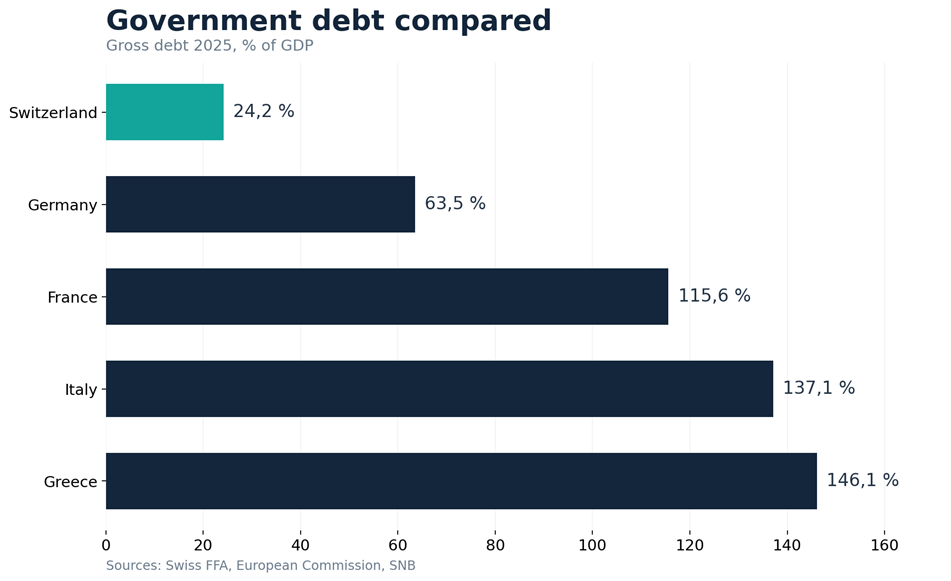
Comparative debt ratios
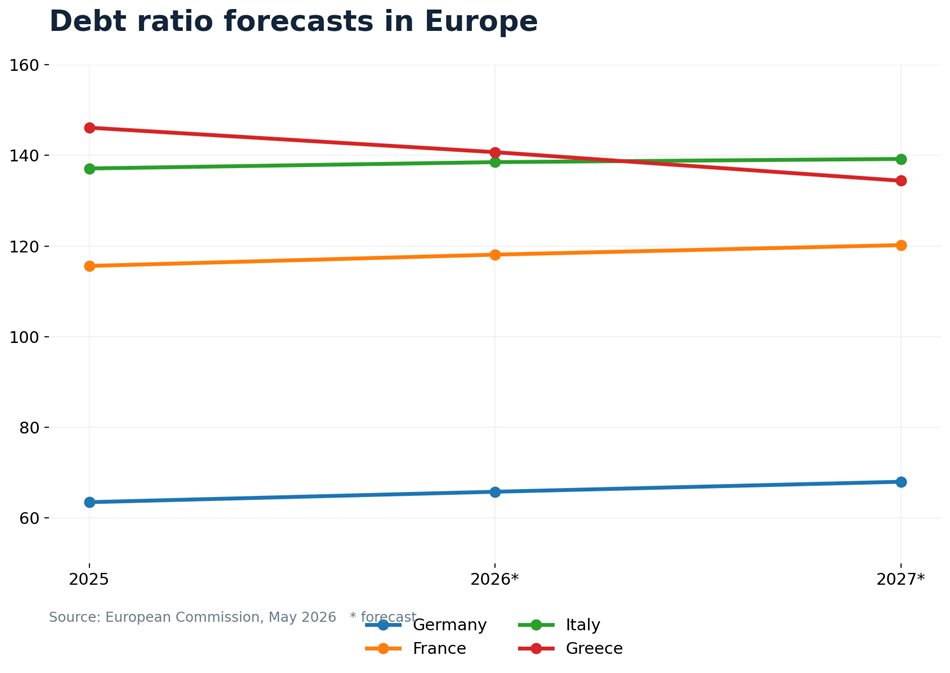
European debt outlook
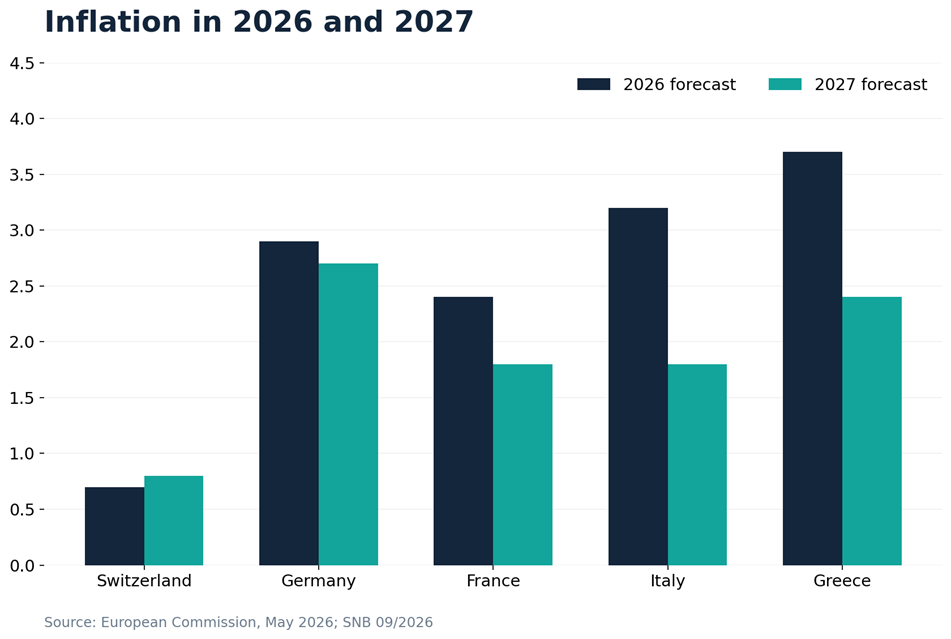
Inflation outlook
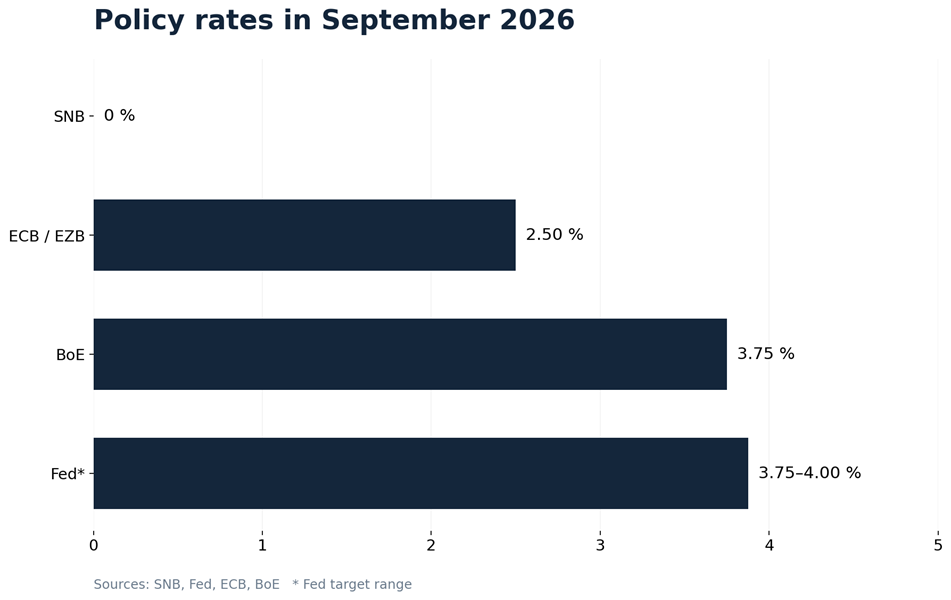
Policy interest rates
- EFV: https://www.efv.admin.ch/dam/de/sd-web/bjAPAViEZor6/Taschenstatistik-2025-d-web.pdf
- SNB: https://www.snb.ch/de/publications/communication/press-releases-restricted/pre_20260924
- DE: https://economy-finance.ec.europa.eu/economic-surveillance-eu-member-states/country-pages-including-country-reports/germany/economic-forecast-germany_en
- FR: https://economy-finance.ec.europa.eu/economic-surveillance-eu-member-states/country-pages-including-country-reports/france/economic-forecast-france_en
- IT: https://economy-finance.ec.europa.eu/economic-surveillance-eu-member-states/country-pages-including-country-reports/italy/economic-forecast-italy_en
- GR: https://economy-finance.ec.europa.eu/economic-surveillance-eu-member-states/country-pages-including-country-reports/greece/economic-forecast-greece_en
- Fed: https://www.federalreserve.gov/monetarypolicy/fomcprojtabl20260916.htm
- BoE: https://www.bankofengland.co.uk/monetary-policy-summary-and-minutes/2026/september-2026
- CBO: https://www.cbo.gov/publication/61882
- FranceNew: https://www.lemonde.fr/en/politics/article/2026/09/19/french-public-debt-to-reach-new-record-level-in-2027-exceeding-120-of-gdp_6757714_5.html
AI transparency: This article was researched, drafted and linguistically edited with assistance from ChatGPT (OpenAI) and Claude (Anthropic). Editorial responsibility rests with the publisher.
Data note: Switzerland 2025 EFV 24.2%; EU 2025 and projections 2026/27 from EC spring forecast; France government scenario September 2026. UK net debt and US federal debt are methodologically different.